One of the most dire diagnoses for a doctor to deliver to a patient is “pancreatic cancer.” Just 13% of its victims live for five years after being diagnosed, according to the National Cancer Institute. Although pancreatic cancer accounts for 3.3% of new cancer cases in the United States each year, it is responsible for 8.4% of cancer deaths — ranking it third among all cancers.
The main reasons: Pancreatic cancer is usually detected at advanced stages, as symptoms become apparent. There are no federally approved screening tests for early detection. The cancer spreads quickly and responds poorly to treatments.
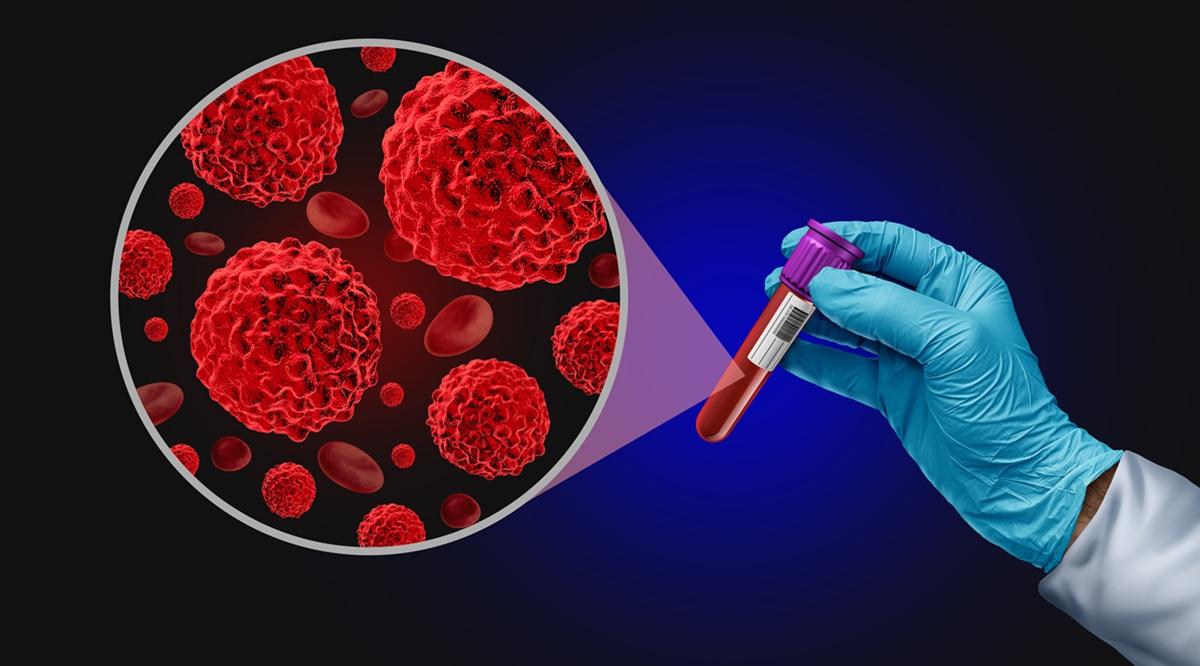
Researchers at Oregon Health & Science University (OHSU) believe they’ve developed a diagnostic tool to reduce those obstacles: A liquid biopsy, in this case a blood test that finds evidence of pancreatic cancer before symptoms arise, opens the way to identifying patients with the cancer, starting treatments earlier, and measuring the treatments’ effect.
In a study using blood samples and medical records from 350 patients (both with and without pancreatic cancer), the test evaluated changes in certain protein activities that indicate the most common and deadly form of the cancer: pancreatic ductal adenocarcinoma (PDAC). The test correctly distinguished healthy individuals 98% of the time and identified 73% of pancreatic cancer patients, according to a study published early this year in Science Translational Medicine.
This innovation is among a plethora of liquid biopsies that are being tested or used to detect dozens of cancers, usually through blood samples but also through urine, saliva, and other fluids.
"Liquid biopsies show promise for discovering many cancers earlier” than they are found now, says Jasmine Zhou, PhD, professor of pathology and laboratory medicine at the David Geffen School of Medicine at the University of California, Los Angeles.
There are, however, questions about the effectiveness of liquid biopsies in the detection of disease and the implications for treatment. The U.S. Food and Drug Administration (FDA) has approved only a few such tests to detect cancer, and insurance companies rarely, if ever, cover the others.
Nevertheless, the tests address a significant need. The FDA has approved screening mechanisms for only five cancers: breast, cervical, colorectal, prostate, and lung, notes Richard M. Hoffman, MD, MPH, emeritus professor of medicine at the University of Iowa Carver College of Medicine. The remaining cancers “account for nearly half of all cancer diagnoses and about 60 percent of cancer deaths,” Hoffman says.
Liquid biopsies can “show signals for a lot of cancers for which we currently have no screening,” says Zhou, also a cofounder and CEO of EarlyDiagnostics, a company that’s developing liquid biopsies.
Hoffman led the development of recently published guidance for primary care physicians whose patients ask about the most ambitious liquid biopsies: multi-cancer early detection (MCED) tests, which simultaneously look for indicators of numerous cancers, including dozens for which there are no standard screenings.
“Multi-cancer blood tests could be a game changer,” says Jagpreet Chhatwal, PhD, lead author of a recent study that simulated the impact of MCEDs, and director of the Institute for Technology Assessment at Massachusetts General Hospital and Harvard Medical School.
How these biopsies work
Liquid biopsies seek signals of cancer rather than the cancer itself. A cancer tumor leaves microscopic footprints by shedding DNA mutations or setting off certain protein activities. Those changes can be detected in bodily fluids. Whereas a surgical biopsy is intended to sample potentially cancerous cells, a liquid biopsy looks for the footprints.
“Part of the tumor dies, and the DNA of those cells is released into the blood,” explains Jose Montoya Mira, PhD, research engineer at the OHSU Knight Cancer Institute, who led the pancreatic cancer study there.
Yet only a few FDA-approved liquid biopsies are routinely used to detect specific cancers, including PSA (prostate‑specific antigen) blood tests, which assess for an antigen that is elevated in cases of prostate cancer, and Cologuard, which assesses stool samples (defined as a liquid for these purposes) for colorectal cancer.
The test developed by OHSU aims to expand the scientific innovation to another cancer. It detected excessive breakdowns in certain proteins that are key indicators of PDAC. Aside from having a 93% overall accuracy for both healthy and cancer samples, the test helped to identify early-Stage 1 cancer patients correctly 85% of the time when combined with a blood test (CA 19-9) that is currently used in the clinic for prognosis.
The test used fluorescent peptides to signal signs of cancer. Blood samples with cancer lit up like the goblins in the Pac-Man video game, Jared Fischer, PhD, assistant professor of molecular and medical genetics at OHSU, said in a panel discussion last May at the annual conference of the Association of Health Care Journalists. (The test is named PAC-MANN, which stands for protease activity-based assay using a magnetic nanosensor.)
As for next steps: Whereas the first cohort was retrospective — using records such as medical charts, along with previously stored blood samples — Montoya Mira says the OHSU research team is analyzing a prospective cohort that will be followed in real time to analyze the test’s performance. In addition, he says, researchers are exploring partners to initiate a clinical trial. The trial, and eventually the product itself, would focus on high-risk patients, as that’s who would benefit most from the test.
“Currently, high-risk patients have no screening method that is accessible,” Montoya Mira says. “We can help.”
Studies are moving forward for other liquid biopsies, including another for pancreatic cancer and one for lung cancer. The FDA has approved some liquid biopsies to help guide treatment decisions for cancer patients.
Yet with almost no liquid biopsies commercially available for detection of single cancers, more patients are turning to tests that, perhaps ironically, look for multiple cancers at once: MCEDs. “The purpose is to capture a broad spectrum of cancer signals,” Hoffman says.
At least two MCEDs are commercially available in the United States: Galleri, from GRAIL, which reported earlier this year that more than 370,000 tests had been ordered since it began selling them in 2021; and Cancerguard, from Exact Sciences, which became available this year.
One analysis of MCEDs, led by Chhatwal at Harvard Medical School, estimated that they could increase Stage 1 diagnoses by 10% and by higher levels in Stages 2 and 3, and consequently reduce Stage 4 diagnoses by 45%.
The availability of liquid biopsies, especially those that screen for multiple cancers, might result in more people getting screened, Hoffman says.
“Being able to get screened with a simple blood test is much easier than having to schedule and prep for a colonoscopy, or going to radiology for a low-dose CT scan,” he says. “By making screening more convenient, MCED testing may increase the number of people who initiate screening.”
Balancing advantages and drawbacks
Liquid biopsies present doctors and patients with several questions about whether to get them and what to do with the results.
Accuracy
Most liquid biopsies are still in developmental or trial stages. For MCEDs that are commercially available, there are no final results on their safety and effectiveness from randomized controlled trials, according to the guidance article for which Hoffman was the lead author. That is among the reasons the FDA has not approved the tests.
“We’re looking for results from randomized trials showing that screening for multiple cancers will reduce the overall risk of dying from cancer,” Hoffman says.
One wrinkle is that because MCEDs look for cancerous signals from material in bodily fluids, they are not always tissue-specific in the way that a mammogram or colonoscopy is. In a minority of cases, MCEDs predict the most likely organs for the cancer rather than specify one.
The follow-up
A positive result from a liquid biopsy leads to a surgical biopsy to confirm the cancer. Those tests can be expensive and physically painful, and stir considerable distress in patients.
“You’re telling somebody, ‘You have cancer.’ That’s super-stressful for anybody,” Montoya Mira says.
A negative follow-up result might mean there is no cancer or that the cancer has not progressed enough for standard detection.
There are still important questions about positive test results. “What’s the best way to evaluate someone with a positive test?” Hoffman notes. “What happens if the workup [after the blood test] does not find a cancer?”
Treatment not needed
Early detection might reveal cancers that don’t need to be treated just yet, but that do need to be monitored. Although this can cause anxiety for the patient, it can result in long-term medical benefits.
“Are we going to diagnose more cancers which are otherwise not going to do any harm?” Chhatwal wonders.
Cost
Because the FDA has approved very few liquid biopsies for disease detection, most insurance companies do not cover them. That leaves patients to pay hundreds of dollars (sometimes close to $1,000) per test. A positive result creates added pressure to spend more on follow-up biopsies.
“If you get a positive result, who’s paying for the follow-up?” Montoya Mira asks.
False security
Liquid biopsies are intended to supplement, not replace, screenings that exist for some cancers.
“People might think they can skip the mammogram or other test because they got this [liquid test] and it was negative, which is not how people should see these tests,” Chhatwal says.
Moving forward
While there might be a time when everyone can be tested for signs of any cancer, that’s not where the science stands today. Widespread testing would not only be costly but would probably produce a large number of false positives, for which there might be expensive and painful follow-up biopsies.
“A reasonable approach is to focus on the high-risk population,” Zhou says.
Hoffman agrees, citing such factors as family or personal cancer history, exposure to carcinogens, and age. That’s what physicians need to focus on when patients ask about liquid biopsies, either for a specific cancer or for multiple cancers.
“The challenge for clinicians is that patients will see MCED testing as an exciting new screening technology that holds the promise for reducing the burden of cancer,” Hoffman says. “Clinicians have to temper that enthusiasm. They need to educate patients that we don’t yet know whether these tests can live up to their promise.”
Still, that promise is significant enough for continued research and development of early detection through liquid biopsies, Zhou says. The evolving technology, she adds, “is a major step forward.”