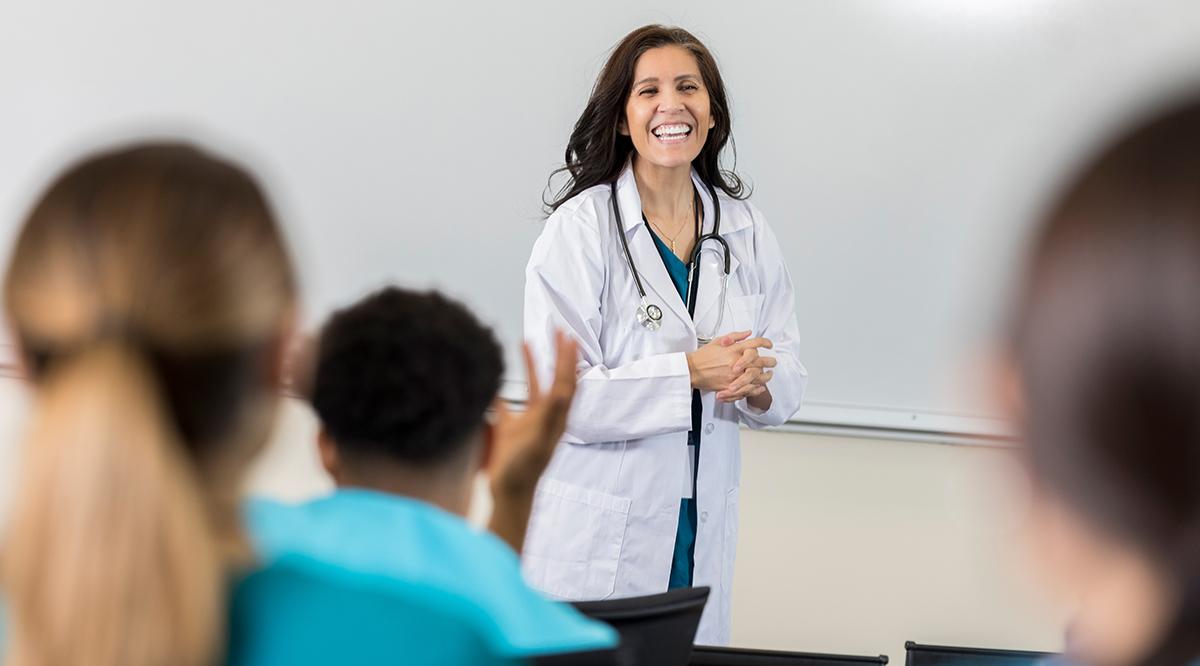
Figure out how each student learns best.
Make them feel safe if they give a wrong answer.
Create high expectations.
Know what’s going on in their lives beyond your classroom.
Those are among the approaches that some of the nation’s best medical school teachers take with their students. The four winners of the AAMC’s 2025 Alpha Omega Alpha Robert J. Glaser Distinguished Teacher Award, and two of their students, recently talked separately with AAMCNews about what makes someone a good teacher and educational innovator.
Their observations stretch beyond medical expertise (that’s a given), into personal relationships with students.
“A lot of it is getting to know their lives,” says David Harris, PhD, professor of medical education at the University of Central Florida (UCF) College of Medicine. “How are they balancing everything else outside of what I’m doing in the classroom? What else do they have going on?
“I realize that I’m not their whole world.”
Below is a summary of teacher and student reflections, primarily in their own words.
Meet students where they are
This is the most common theme mentioned by teachers and students. They describe the process as knowing how each student learns, their strengths and their struggles, and their lives within and beyond academics.

David Harris, PhD
Harris serves as lead educator for cardiac and respiratory physiology at UCF College of Medicine: “I didn’t grow up till I was 26 years old, but our average students are below 26 years old. They’re dealing with a lot of life issues in between [classwork]. I’ve been known to just walk down where I know they study and hang out with them. ‘Hey, what’s going on?’ Knock down the barriers a bit.”
Melissa Fischer, MD, MEd, associate vice provost for interprofessional and instructional innovation at the University of Massachusetts T.H. Chan School of Medicine, developed UMass Chan SOM’s first core curriculum for acting interns:
“One of the best teachers I had in medical school was a clinical teacher who was a surgeon, who demonstrated his deep caring for you. Respect demonstrates caring — respect for what the student brings to that experience.
“Our students come to us with all kinds of experiences. It’s trying to take an individual interest in who that person is and what they’re going through. It’s very easy in a hierarchical system to shut the door on those who are learning at other levels than you are.”
Amanda Brito, MD, MPH, learned from Lisa Willett, MD, MACM, at the University of Alabama at Birmingham (UAB) Marnix E. Heersink School of Medicine. Brito, who got to know Willett through clinical rounds during her fourth year, is now on the faculty at UAB:
“She [Willett] takes a lot of care to get to know where individual learners are in their education and in their skills, and targets her approach to their level.
“Dr. Willett and other teachers at UAB taught me that it’s not the same for every learner. You cannot use a cookie-cutter approach, where I’m going to ask questions in this way and expect everyone to give the same answer.”
Help them feel safe about not knowing
It’s natural for students to be intimidated by medical school and by their teachers. But these teachers say they learned best from those who made them feel safe saying that they didn’t know an answer to a question. They’ve adopted that approach in their own teaching.
Willett, who additionally serves as vice chair for education and faculty development in the Department of Medicine at UAB, has helped shape the culture of education and learning there:
“It’s not constructive for people to be in fight-or-flight mode all the time. Creating an environment where there’s appropriate stimulation to learn is better than terrifying people that they’re going to make a mistake.”
Brito, about Willett:
“Something I learned from her: None of us knows all the answers. It’s much better for you to say, ‘I don’t know.’ We did a lot of work around making sure that we had a culture of psychological safety.”
At the same time, the teachers recognize that the life-and-death nature of medical care imposes pressure on health care providers. The challenge is knowing when that tension is useful, to compel the best decision-making, and when it gets in the way because the teacher is instilling unnecessary trepidation.
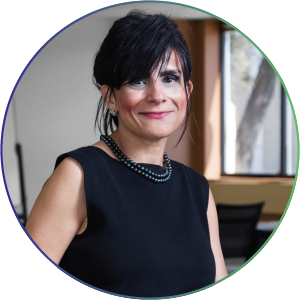
Sherine Salib, MD
Sherine Salib, MD, professor of internal medicine at the University of Texas at Austin Dell Medical School, is also associate dean for curriculum and serves as an inpatient and outpatient teaching attending physician at Dell Med:
“The medical setting is necessarily uncomfortable. I tell them that you’re going to be uncomfortable, and discomfort is a part of growth. But I don’t want you to be living in unnecessary pain.
“If I am harsh, don’t connect with my students, have unrealistic demands, I contribute to that unnecessary pain.”
Willett recalls asking a group of residents, during rounds, about deciding when to acutely dialyze someone who is in sudden kidney failure. Nobody had an answer:
“I was, like, ‘Good. If nobody knows, you all made me happy. We're going to talk about it,' as opposed to, ‘What do you mean you don’t know?’”
Harris recalls a moment when “a very established nephrologist” demonstrated humility in front of the classroom:
“One of the students asked him a question, and he stepped back and said, ‘I don’t know.’ That had a great influence, because you don’t see many professors with the courage to say, ‘I don’t know.’
“That’s what we should be instilling in our students: to be comfortable with saying they don’t know.”
Expect excellence, warmly
While making students feel safe, teachers must still maintain high expectations.
Fischer:
“How do we learn from medical errors? It's important to lean into those things that are more challenging.
“Fear is healthy. Fear tells you, ‘This is something I need to be careful about.’” After a mistake, “recognize it and move forward, reach out to supports and resources,” to learn.
Salib:
“Be a warm demander. It’s important to be warm enough where the learner can feel that you’re approachable, that you care about them. That can go hand in hand with having high expectations.”
Brito, about Willett:
“Creating the right amount of pressure creates a good learning environment. Being too comfortable is not good. You need to be a little bit outside of your comfort zone to learn and to develop your skills.”
Brito describes how Willett questioned students:
“‘I’m not putting you on the spot to make you nervous. I’m putting you on the spot for us to grow.’ She’s very intentional about helping to identify areas for you to improve, and calling out the things that you’re doing well.”
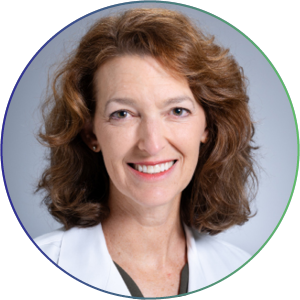
Lisa Willett, MD, MACM
Willett:
“If their presentations are a disaster or they’re making the wrong decision, say, ‘I appreciate you trying. This is hard.'”
After noting what’s wrong, note what’s right: “You’re doing a great job of recognizing X, Y, and Z.
“Be intentional about compliments and building a positive learning climate, and setting expectations. Once you build that trust, they get a sense that you care about them. Then they’re comfortable asking about what they don’t know.”
Help them relax
Salib:
“We’re dealing with death and dying on a daily basis. It’s heavy. It can take a toll on people. It’s important for learners to be able to see the seriousness of this, but at the same time feel comfortable enough in their learning space to drop their guard a little bit and have fun with others who are in that same situation.
“If you’re constantly operating with stress and tension, you cannot absorb things.”
Ariana Johnson, a fourth-year student at UCF College of Medicine, has had several classes with Harris:
“He’s super fun. He spent part of his time in Philly. There was this one concept we were learning about, in pulmonology. He used a Philly cheesesteak to explain this concept of air getting to our lungs and oxygen getting to our bloodstream.
“You can have an issue because something is stuck in the airway, blocking oxygen, or something is blocking the blood vessels that pick up oxygen. If you are choking on a Philly cheesesteak, that’s the issue. But you could have an issue in the bloodstream where you have a clot, so oxygen is not being received [into the bloodstream], even though air is getting there. Is it a Philly cheesesteak problem?
“That stuck with me.”
Let them get to know you as a person
Harris:
“The teacher who probably had the greatest impact on me was Dr. Maria Tahamont, my physiology teacher in undergraduate. She got me hooked on physiology, through her enthusiasm. I remember times that her son would be in class because he was off from school and she didn't have anybody to watch him.”
Harris often talks about his wife, who is from Brazil, and their children. He recalls the good vibes from students when he brought the children to class during a session to review exam results:
“They were, like, 8 and 4 at the time. I was the course director so I wasn't directly involved in any of the questions. My kids just kind of laugh. They’re, like, ‘Dad, you don’t do anything. You just sit there and talk to students.’”
Adjust based on student response
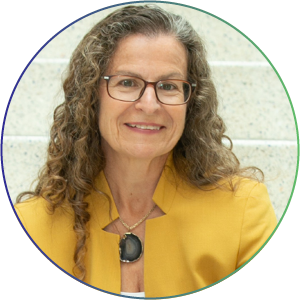
Melissa Fischer, MD, MEd
Fischer:
“When I was a young medicine clerkship director, I was all-in about learning portfolios: the self-reflection, the individual learning plans, the demonstrations of learning with self-evaluation, peer evaluation, and faculty evaluation. I was so excited about this, I dove into implementing it full-on.”
The students struggled to meet Fischer’s expectations for their portfolios. The teacher saw that she had not given them enough guidance on the why and how of the exercise.
“I realized I was asking people to do a lot of things that they weren’t prepared to do. I hadn’t done all the change management [instruction] around making sure people understood what the objectives were and what the needs were.”
She pulled back on the assignments and redesigned the exercise with more up-front groundwork.
Willett:
In her early days working with residents, Willett did a lot of lengthy “chalk talks,” explaining a topic while writing on a white board after rounds with patients. She saw that their attention waned.
“They’re busy, they’re getting paged, they’re constantly distracted.”
Willett modified her talks to focus on one thing to learn from a particular patient during rounds:
“I will say, ‘Here’s the one-pager on this topic about this patient that I want you to remember. That is the teaching point.’”
Salib:
But don’t make adjustments just to be well liked.
“I’ve gotten a lot more relaxed about, ‘What do my learners think of me?’ I’ve learned that if I care about them and I’m intentional about doing right by them, then the feedback will naturally come back and be positive. So it was more about doing the right thing, caring about my learners, and caring less about the feedback.”
Advice for newer teachers
Keep learning and adapting.
Willett:
“You will become better doctors because of the people and the learners around you. You learn so much because you want to give your best to them, so you continually try to get better yourself. You continue to grow and learn, and do things in different ways.”
Recognize the impact you have on future physicians, even in small moments.
Salib:
“One thing that really impacted me was how influential teachers are in a learner’s journey. A teacher can go about their day not realizing how much they can impact a student’s trajectory. Sometimes it’s just a word or a sentence you say, an encouraging moment, or something that you tell a student that they carry with them throughout their lives.
“We impact learners’ lives to a larger extent and for a longer time than we often realize.”