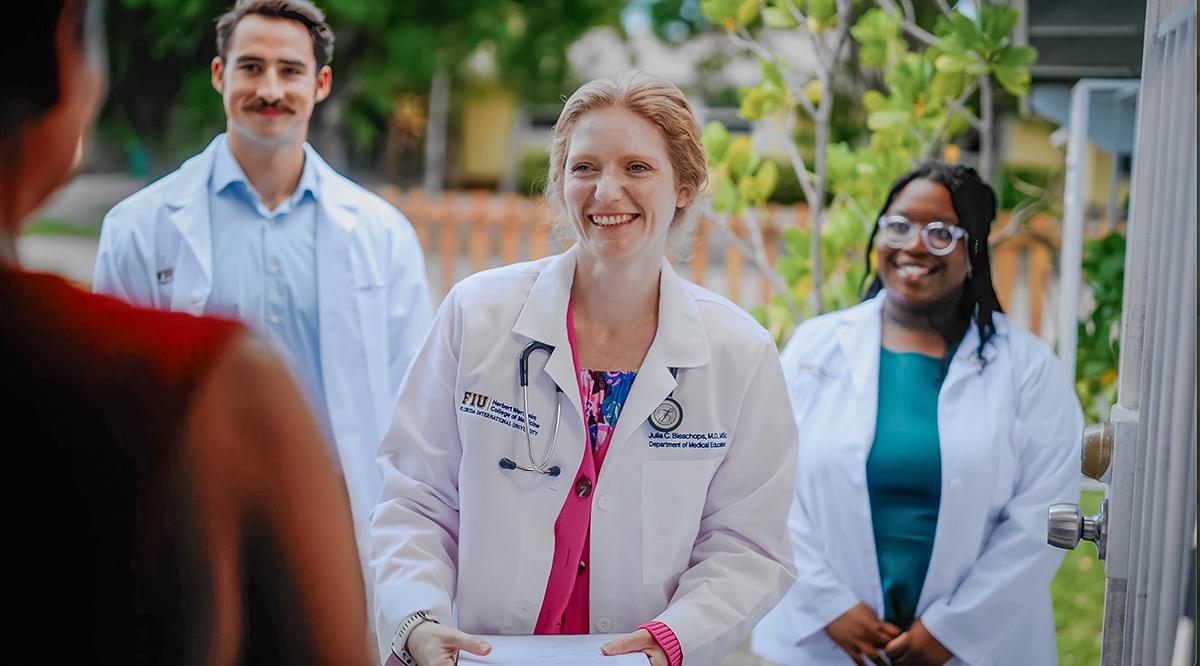
Beginning in the first year of medical school, students from the Florida International University (FIU) Herbert Wertheim College of Medicine fan out across underserved communities in Miami-Dade County in interdisciplinary teams. The doctors-in-training — along with those studying to be nurses, physician assistants, social workers, and sometimes even attorneys — create and oversee treatment plans to care for a single household. The future doctors will carry this responsibility for three of their medical school years.
Not only does this longitudinal component of their training give them direct exposure to the social and environmental influences on their patients’ health, from food insecurity to the need to access disability benefits. It also teaches them the roles of those in allied professions and how to communicate effectively — all preparation for the real world of clinical medicine.
Fourth-year FIU medical student Rima Avellan’s assigned family were uninsured immigrants who lived in a dilapidated rental house. The mother of the household struggled with obesity, hypertension, and uncontrolled diabetes.
“I was not familiar with that level of poverty,” Avellan says. “The first day we went, there was a flood in the kitchen, and we could see termite droppings. [Family members] were complaining of rodents.”
Over the next three years, while Avellan and a physician assistant-in-training attended to the family’s physical needs — tracking needed medications and teaching the family the basics of macronutrients and calorie counting, for instance — the social work intern located nearby food banks and eventually helped to find the family a new home.
“As a medical student, you think you have to do everything yourself,” says Avellan. “But here you see that every role has an important place in the outcome of patients.”
The program is just one example of the innovative efforts taking place at academic health systems as part of interprofessional education (IPE). The concept is defined as experiences where “students from two or more professions learn about, from, and with each other to enable effective collaboration and improve health outcomes.”
“No matter what field of medicine you go into, you’re not the Lone Ranger,” says David R. Brown, MD, professor and founding chief of family and community medicine at FIU’s Wertheim College of Medicine and one of the architects of the Green Family Foundation NeighborhoodHELP program, the required service-learning experience that Avellan participated in. “Everybody works in teams these days, so our students are getting an early experience of actually having a team to work with.”
"From my experience as a clinician, patients receive the best care when the whole team contributes and works as a team,” adds Alison Whelan, MD, AAMC chief academic officer and immediate past chair of the Interprofessional Education Collaborative (IPEC), which promotes educational efforts focused on team-based care. “And our work is easier, more efficient, and more satisfying.”
An evolving practice
IPE is not new — training in interdisciplinary teams dates back decades. But the concept picked up steam after the Institute of Medicine’s seminal 2000 report, To Err Is Human, revealed that medical errors — including those linked to a lack of coordination between health professionals — were responsible for 98,000 deaths a year. That led to a surge of reform and innovation in medicine and education.
“Over the past two decades, interprofessional education has moved from ‘nice to have’ pilots to a more mainstream, competency-based, accreditation-relevant expectation,” says Lisa Howley, PhD, AAMC’s senior director for transforming medical education.
A critical juncture was the establishment of IPEC in 2009 by six national associations of health professions, including the AAMC. IPEC developed the four core competencies of IPE (values and ethics; roles and responsibilities; interprofessional communication; and teams and teamwork) and offers faculty-development courses and programming for the broader health-professions-education community.
As a result of such efforts, IPE is now a bedrock principle of medical training.
“U.S. medical schools aim for IPE in some fashion, as it is an accreditation requirement and embedded in our competency framework,” Howley says. “Learners are expected to work effectively with professionals from other disciplines to deliver safe, high-quality, equitable care.”
Accumulating data suggest that IPE is succeeding at just that. A 2024 review of research found “associations between IPE and improvements in key quality measures, such as length of hospital stay and medication errors,” Howley says.
A variety of approaches
Medical schools drive IPE in multiple ways, both within and adjacent to the formal curriculum.
“Every school is different,” says Whelan. “Their mission, the community they serve, and who they might have as other professional learners is different, so the way that schools have embraced interprofessional education is variable.”
Many colleges offer team-based classroom learning, which can take the form of case-based discussions, small-group problem-solving, seminars on topics such as ethics or health systems, and simulation-based team training online or involving standardized patients (actors portraying patients) or medical manikins. Since COVID-19, virtual and hybrid training have been popular.
“People are moving away from just one-day workshops,” Howley adds. “More IPE is situated in community settings and oriented toward populations and health equity.”
At the Ohio State University College of Medicine, IPE is integrated into the MD curriculum through the university’s broader BuckIPE (Buckeye Interprofessional Practice and Education) framework, which involves, in addition to medical school students, learners from other health sciences and allied programs. BuckIPE learning includes structured activities such as collaborative case discussions with students from different health programs; team projects; simulations; community, clinical, and other forms of interprofessional collaboration; and facilitated reflections on interprofessional practice.
A signature component of BuckIPE is the Interprofessional Community Scholars Program, in which interprofessional teams of students are paired with community mentors — people with chronic health issues — over the course of a semester, to address gaps in care.
“After assessing their health needs, the mentors set goals, and the team students help them achieve their goals,” says Andrea Pfeifle, EdD, PT, Ohio State’s associate vice president for interprofessional practice and education. “For example, if they want to be on a walking program, but they don’t really know where to do that, the team will help them find a place or help them identify different programs in the community.”
The power of simulation
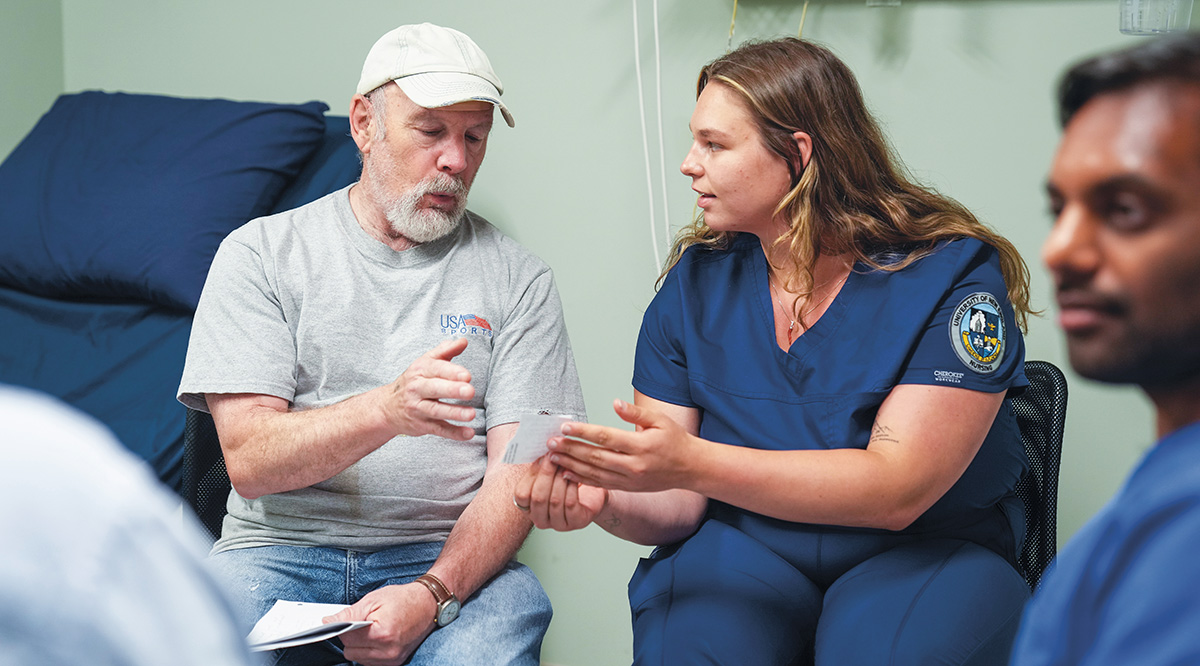
“Michael,” a standardized patient, chats with third-year nursing student Alexa Lanteri and first-year medical student Varun Kota, at the University of New England.
Credit: The University of New England
Simulation is a particularly potent tool for inculcating the value of teamwork. At the University of New England, multidisciplinary groups of learners — including those in the nursing, medicine, pharmacy, and dentistry programs, as well as those in training for several other allied professions — meet “Michael,” a 74-year-old veteran from a rural part of Maine. Michael doesn’t like asking for help, but he needs assistance to manage a complex set of health conditions.
Michael isn’t actually a patient. He’s a standardized patient — in this case with a challenging demeanor.
“He’s a very proud individual,” says Ashley Buckingham, MSN, RN, CHSE, senior director of the university’s Interprofessional Simulation and Innovation Center. “When he comes to the table to meet the students, they have to figure out, ‘How do I have a conversation with him? How do I figure out what he wants out of his own care and life?’”
The experience can be humbling, says Buckingham. “Often the takeaway is something like, ‘Oh, I didn’t realize that a physical therapy student knew so much about x, y, or z,’” she says. “Many students end up saying, ‘I don’t know much. I’m leaning on all of you in other health professions to help me move through this sim.’ It’s really cool to watch them all see that they have something to teach each other and learn from one another.”
Preparing for future challenges
At Howard University College of Medicine, interprofessional education is integral to all the health sciences. Training with standardized patients is particularly effective. One scenario that stands out for Tamara Owens, PhD, MEd, founding director of Howard’s Health Sciences Simulation and Clinical Skills Center, is a simulation on microaggressions.
“Our learners often face microaggressions when they’re out in the clinical space, with patients or other health care workers,” she says. “The simulation goal was to introduce learners to a common microagression scenario, so they can identify when a microaggression happens and figure out, how do you address the health professional and still take care of the patient? That’s critical. The debrief on those sessions can be very emotional, because sometimes it’s triggering for the learner.”
The university offers a broad range of experiential learning activities that bring together health sciences students with peers from across campus. That might even include divinity, political science, and arts students.
IPE teams participated in Howard University Research Day, which required them to collaborate on a patient case and produce a scholarly project to present as a poster or oral presentation.
“The IPE committee gave the teams case scenarios to choose from and asked them to submit an abstract on how the team would approach the case,” says Owens.
The paper was due in several weeks, during which the students quickly learned that coordinating the efforts of different team members was one of the toughest challenges of the assignment, she adds. That was intentional.
“This was not just another task or paper,” Owens says. “The committee wanted them to understand that this is groundwork for [how they will work] in the clinical setting, where response times can be critical to the patient’s health outcomes. When you’re working with other health care providers and they’re not responding, how do you communicate effectively to let them know the urgency of what’s needed for the care of the patient?”
At the same time, the quality of the interprofessional scholarship was remarkable. “These were some of the most impressive presentations,” says Owens.
Achieving better outcomes
IPE may lead to students’ success in other ways — for example, making them more competitive for residency placement, says Nana Aisha Garba, MD, PhD, MPH, associate professor and supervising faculty physician for FIU’s NeighborhoodHELP program.
“Our fourth-year students consistently report significant interest in the program during their interviews,” she says. “They believe that it gives them an advantage.”
But the real beneficiaries are the people the various IPE programs serve. Early data from the NeighborhoodHELP program showed that it cut emergency department use in the community in half, and individuals in participating households were more likely to have undergone physical exams, blood pressure monitoring, cervical cytology screenings, and other preventive health measures, compared with similar households not in the program.
FIU’s program has been so successful that in 2020, the founders exported the concept to Clark County, Nevada’s Roseman University of Health Sciences, which admitted its first class of medical students last fall. These first-year students will soon begin home visits in the community service-learning program, called Genesis.
“We’re going to pair up the students and have them follow two underserved families for the duration of medical school,” says Pedro “Joe” Greer Jr., MD, dean of the new Roseman University College of Medicine and a founder of both NeighborhoodHELP and Genesis, where the school’s leadership itself reflects interprofessionalism. “Among the five of us at the top, only two of us have MDs,” he says.
Greer believes the idea could be replicated at many other schools, improving both medical education and health care outcomes in the nation’s most disadvantaged communities.
“If a team is not involved, an individual is not going to resolve [these families’] health problems,” he says. “The future of medicine is the team.”
Resources
- Interprofessional Education Collaborative
- Interprofessional Education Collaborative Core Competencies
- Foundational Competencies for Undergraduate Medical Education
- LCME Standards and Elements, Principles for Education to Develop Interprofessional Collaborative Skills (Element 7.9)
- NASEM Global Forum on Innovation in Health Professions Education
- National Center for Interprofessional Practice and Education (NEXUS)
- MedEdPORTAL
- TeamSTEPPS (a widely used teamwork-training approach in practice settings)