Learn more about planning and executing Project Medical Education at your institution with guidance from individuals who have hosted PME before.

Ross Frommer, Vice President of Government Affairs and Associate Dean at Columbia University Irving Medical Center
What led to the decision to host a Project Medical Education program, or similar event, at CUIMC?
I became aware of the PME program soon after I came to Columbia. In fact, just before I arrived, Columbia co hosted the first PME program. I could see immediately that PME was an excellent way to educate policy makers about what happens on a day to day basis at an academic medical center like Columbia. After hosting two PME with primarily DC based health staff, we realized that there were so many other audiences that could benefit from the PME experience. I reached out to my colleague Sandra Harris and together we adapted the program for a more local audience – neighbors, community leaders, community based organizations, and state and local policy makers. Wouldn’t it be great if they could all participate in a PME at Columbia? And that is the program that we now run each year.
Once the decision was made, what helped secure buy-in to move it forward?
A couple of things. Our first local PME back in 2011 was a success. The participants raved about it and strongly encouraged us to keep doing it. They also recommend others who we should invite, and to this day members of the original cohort still give us names each year, as do other program alumni. Of course it is important to have buy in from leadership and faculty which we do have.
How did you pull off a successful PME day at your institution?
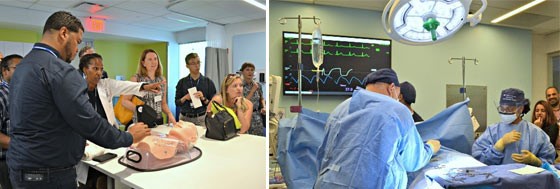
First of all, try to keep the group moving and involved. Create as many hands on activities as possible. Visit different parts of the campus. Yes it is more complicated, and sometimes a little stressful to travel from building to building but it is so much more engaging and frankly fun than having the group sitting in the same classroom all day listening to various presentations. Obviously, you can’t cover everything but try to touch on as many different parts of the institution as possible. We always visit all four of our schools and try to best explain the many aspects of our mission.
What is interesting is that yes, each year there is an AHA moment, several of them, but they are different from year to year and from person to person. In all our years of doing this I do not think we have ever had a session that people thought we should not have included in the program.
What advice would you give to an institution hosting their first PME?
Coordinate, coordinate, coordinate. Obviously with faculty and leadership, but also with communications, general counsel, public safety, facilities, etc. Avoid surprises but understand, something will go not according to plan. Be ready to adapt. Make sue you allocate enough time for each session and for travel. Makes things nice but not overly fancy. It will be a very long day for you, your staff, and for the participants but that is OK, Our faculty, students, and staff work hard and it is important that people understand that. To the extent possible insist that participants stay for the entire program. Having people come and go can be disruptive. Above all else, have fun with it.
Jessica Davis, Assistant Vice President of Federal Affairs at Emory
What led to the decision to host a Project Medical Education program, or similar event, at Emory?
When I was a Congressional staffer, I learned so much more about an issue by seeing it in action. From research labs running experiments to rounding with health care providers, each staff trip made an impact on what I brought back to Capitol Hill. Emory and other Georgia institutions have a great history of bringing staff to campus every year—it just made sense to include Project Medical Education as part of the Emory story.
Once the decision was made, what helped secure buy-in to move it forward?
We do a large staff day every year in the fall. It has become an expected event for both our internal and external offices. Each year, we tailor the program to what is currently happening on the Hill. The Emory Office of Government and Community Affairs represents the university as well as 11 hospitals, so there is always something to show off.
How did you pull off a successful PME day at your institution?
My biggest piece of advice is to keep the group moving—save the PowerPoint for another audience. While we do start the day with an overview from someone in leadership about Emory, after that we are moving from place to place. Some notable visits have included watching a surgery, holding roundtables with frontline nursing staff who served during COVID, visiting our Serious Communicable Disease Unit, and even having a group deliver a baby in our simulation lab. Congressional staff love engaging with our frontline health providers, so I try to fill the day with as many different people as possible. I also think it’s a great opportunity for Congressional staff from both sides of the aisle to get to know each other, so we leave some time for that too.
What advice would you give to an institution hosting their first PME?
Start small—you don’t have to do a full staff day your first time. Invite a group to come to campus for a morning or afternoon. Pick two to three things you want to show off that are uniquely situated to your institution. Keep in mind: How can I make this an easy yes for people with busy calendars? What does parking look like for them? How far apart are the different areas I want them to see? What is the one thing I want them to walk away knowing? I finish all events by 3 p.m. so no one’s last memory of Emory is sitting in Atlanta traffic.

LaShannon Spencer, PhD, Vice President of Government Affairs at Morehouse School of Medicine
What led to the decision to host a Project Medical Education (PME) program at Morehouse School of Medicine?
Morehouse School of Medicine recognized that many federal policymakers and congressional staff make decisions that directly influence healthcare education, research, workforce development, graduate medical education, and access to care, yet few have the opportunity to see firsthand how those policies affect institutions and the communities they serve. Rather than simply asking elected officials to support our priorities, we wanted to create an experience that would deepen understanding through direct engagement. Project Medical Education offered the ideal platform to move beyond traditional advocacy by allowing congressional staff to witness our mission in action.
The timing was intentional. Healthcare is undergoing significant transformation through changes in Medicaid, research funding, physician workforce policy, and public health investments. We believed it was essential for policymakers to see not only the challenges facing academic medicine, but also the innovative solutions being developed at Morehouse School of Medicine to improve health outcomes and address workforce shortages across Georgia and the nation. Ultimately, this special event was championed through our Office of Government Affairs with strong support from President and CEO Dr. Valerie Montgomery Rice, who recognized that meaningful relationships are built through education, transparency, and authentic partnership.
Once the decision was made, what helped secure buy-in to move it forward?
The strongest source of buy-in came from a shared understanding that government affairs is not the responsibility of one department. It is an institutional strategy. Our faculty, researchers, clinicians, students, residents, and executive leaders understood that each interaction with congressional staff represented an opportunity to demonstrate the collective impact of Morehouse School of Medicine. Every mission area—including our four pillars: education, research, clinical care, and community engagement—has a story that connects directly to federal policy.
Support grew quickly because people recognized that this was not simply another campus visit. It was an opportunity to educate policymakers about the return on federal investment while showcasing how Morehouse School of Medicine is preparing the next generation of healthcare professionals, advancing scientific discovery, and improving health outcomes in communities that have historically been underserved.
When individuals understand that advocacy begins with education, institutional engagement becomes a shared responsibility rather than a government affairs initiative alone.
How did you pull off a successful PME day at your institution?
Our approach was simple: to create an experience for our attendees and not an agenda. Rather than relying solely on presentations, we designed an immersive day that allowed congressional staff to interact directly with the people whose work advances our mission. Throughout the day, participants engaged with executive leadership, faculty, researchers, clinicians, students, residents, and community partners through discussions, demonstrations, laboratory visits, and campus experiences that showcased each of our four mission pillars. We intentionally connected every session back to federal policy—demonstrating how congressional decisions influence physician training, biomedical research, community health, healthcare innovation, and patient access.
Perhaps the most memorable moments occur when visitors hear directly from students and residents. Those conversations transform policy from abstract legislation into real people, real communities, and real impact. Staff members often leave with a deeper appreciation for the role academic medicine plays in strengthening the nation's healthcare system and why sustained federal investment matters. Success comes from allowing policymakers to experience the mission rather than simply hearing about it.
What advice would you give to an institution hosting their first PME?
Think beyond logistics and focus on the experience you want policymakers to remember. Every session should answer one fundamental question: Why does this matter to the people making federal policy? Do not overwhelm guests with excessive presentations or data. Instead, tell compelling stories supported by evidence. The combination of personal narratives, measurable outcomes, and meaningful interactions creates lasting impressions that statistics alone cannot. Most importantly, involve the entire institution. Congressional engagement should reflect the collective strength of your organization, not just the work of your government affairs office.
When faculty, researchers, clinicians, students, residents, and community partners all help tell the institution's story, policymakers gain a far more complete understanding of your impact. If I could offer one piece of advice, it would be this: Do not treat PME as a single-day event. Treat it as the beginning of a long-term relationship. The goal is not simply to host an exceptional visit; it is to build trust, deepen understanding, and create partnerships that continue long after guests leave campus. Those relationships ultimately become the foundation for informed policymaking and lasting support for academic medicine.
Mark Brieve, Director, Community & Government Relations at Michigan State University College of Human Medicine
What led to the decision to host a PME (or similar event) at Michigan State University College of Human Medicine?
Project Medical Education is a unique opportunity for policymakers to have a hands-on, interactive experience. The program allows them to understand the life of a medical student — from the first year of medical school through residency to employment as a health care professional. Participants also have the opportunity to interact with faculty, residents, and medical students, and ask them about their lived experiences.
Once the decision was made, what helped secure buy-in to move it forward?
To have a successful event, it was important to secure the support of college leadership as well as our hospital partners. Additionally, it was critical to work with individual lawmakers and their staff to determine dates that worked best for their schedules.
How did you pull off a successful PME day at your institution?
The building blocks for a successful event always started with our volunteers. Finding the right faculty, residents, and students who were willing to help with simulation activities and hospital rounds has always been absolutely crucial. It's also important to equip those volunteers with proper training and talking points, so they're well prepared to interact with PME participants.
What advice would you give to an institution hosting their first PME?
Make your event as interactive as possible. Simulation activities and hospital rounds always receive the most positive feedback. I highly recommend keeping lectures and PowerPoints to a minimum. Also, think about how best you can maximize their time, while still giving them all the information you're hoping they take away from your event.