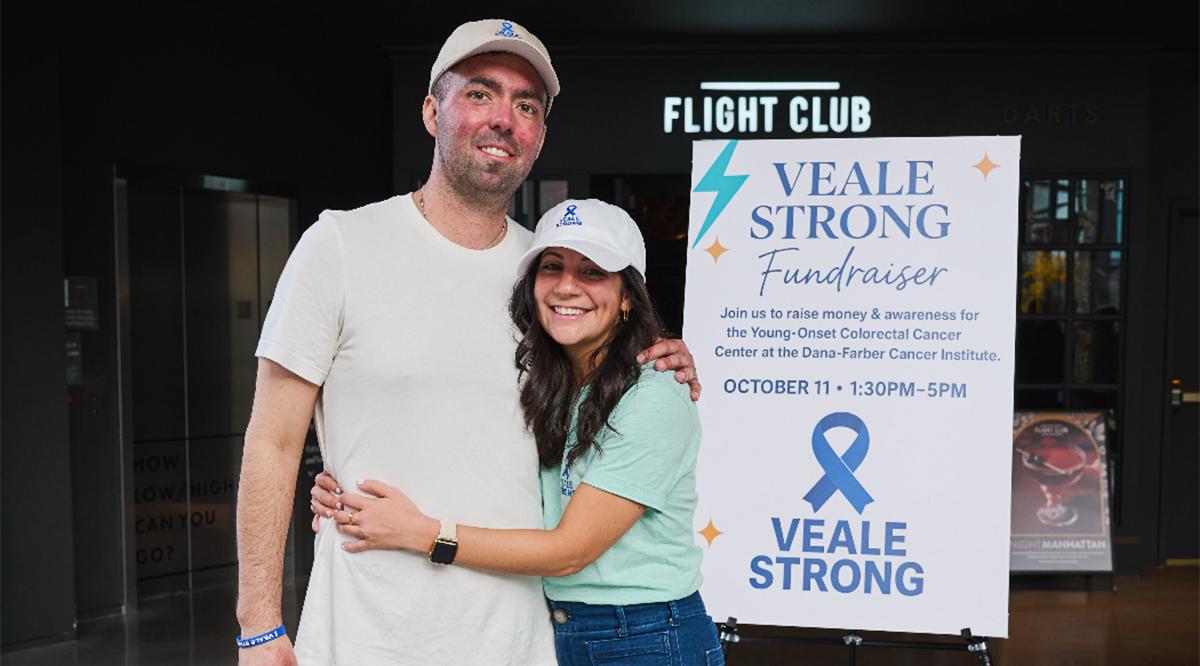
It was around Christmas in 2024 that John Veale first spotted blood in his stool.
Chalking his symptoms up to hemorrhoids, the then-31-year-old from Boston didn’t worry too much: “I was working and going to grad school at the same time,” he says. “I had a lot on my plate.”
But when the problem persisted, Veale finally got a colonoscopy — six months later. The diagnosis? Stage 4 colon cancer.
Veale exemplifies one of the most baffling trends in oncology — a sharp spike in colon and rectal cancers among people under 50 over the last several decades, even as overall incidence and mortality from the diseases have been declining.
In fact, the proportion of colorectal cancers diagnosed in people younger than 55 has doubled, from 11% in 1995 to 22% in 2022, according to recent data from the American Cancer Society (ACS).
“It’s an absolute mystery and one of the big unanswered questions in medicine right now,” says Kimmie Ng, MD, MPH, the founding director of the Young-Onset Colorectal Cancer Center at Dana-Farber Cancer Institute in Boston. “Why are so many getting colorectal cancer at a younger age?”
Finding the answer to that question has become a major academic research priority in recent years. And while researchers have identified many factors linked to the higher incidence of colorectal cancer, nothing fully explains the precipitous rise of disease in young people.
Getting to the root of early-onset cancers
Epidemiological trends suggest that the rise in early-onset colorectal cancers follows what is called a birth cohort effect.
“That means the disease risk is increasing by generation,” Ng says. “Every generation born after the 1960s or so has had a rise in the risk of developing this disease. A person born in 1990 has quadruple the risk of developing rectal cancer and over double the risk of developing colon cancer as a similarly aged person born in 1950.”
The surge of cases points to factors other than changes to the human genome, which would be expected to take much longer than a few decades. Researchers have tended to focus on environmental factors to explain the increase — from lifestyle factors like diet and obesity to exposure to chemicals and changes to the microbiome, the millions of bacteria that live in the gastrointestinal tract and affect health.
“When we see these birth cohort effects, it usually means that a recent environmental exposure or environmental change is likely contributing to the rising rates,” Ng says. “That is what a lot of our research is looking into. What are the environmental factors, whether they be diet or lifestyle or something novel in the environment, that happened right around that time that could potentially be contributing to these rising rates?”
Ng says that colorectal cancer is one of the cancers most strongly linked to diet and lifestyle. “By far the leading hypothesis of why early onset cancers in general are rising in young people is obesity,” she says.
Among adults ages 20 to 39, the prevalence of obesity has more than doubled over the last 25 years, from about 18% in 1988-1994 to 40% in 2017-2018, while obesity among adults ages 40 to 59 rose from 28% to 45% during that same timeframe, according to data from the Centers for Disease Control and Prevention.
Researchers have found that sedentary behavior, prolonged sitting, the consumption of sugar-sweetened beverages, and vitamin D deficiency also play a role in a person’s colorectal cancer risk. “Vitamin D seems to be protective as long as you are getting an adequate amount,” Ng says.
The rise of ultra-processed foods (UPF) as a portion of the diet also parallels the rise of early-onset colorectal cancer. And in fact, research has shown an association between the disease and a high UPF diet. A 2026 analysis from the Nurses’ Health Study II, the long-running study tracking the health and lifestyle behaviors of hundreds of thousands of women, showed that those with the highest consumption of UPFs had a 45% higher risk of developing adenomas, precursor polyps associated with colorectal cancer.
Dana-Farber research also suggests that being breastfed increases the risk for colorectal cancer, for reasons that aren’t clear.
“That has been shown in another large prospective study as well,” Ng says. “We don't know the mechanism yet, but it highlights that we think whatever the diet and lifestyle or environmental exposure may be, we believe the critical window of susceptibility is early life. We don't know if it's in utero, or if it's during infancy or childhood, and a lot of work is being done to tease that out.”
More evidence for early life exposure
Researchers got a startling new clue to the mystery of early-onset colorectal cancer last year when they analyzed blood and tumor tissue of almost 1,000 colorectal cancer patients across 11 countries, then used DNA sequencing to find genetic mutations. Exposure to carcinogens leave “footprints” known as mutational signatures, and the team identified a signature associated with colibactin, a genotoxin produced by certain strains of E. coli and other bacteria.
“We saw a striking enrichment — about three to four times more of this signature — in early onset cases, especially among the patients under 40, as compared to older people,” says Ludmil Alexandrov, PhD, a professor of cellular and molecular medicine at the University of California San Diego and the lead author of the study, which was published in the journal Nature.
“We tried to understand when the mutation happened and our estimates are in the first ten years of life,” he says. “The biggest window is somewhere between 9 and 18 months.”
Colibactin-producing bacteria are much more common in children in industrialized countries, Alexandrov says. An estimated 40% to 50% of children in the United States and Western Europe harbor the bacteria, compared with about 5% in some developing regions, he says.
“The fact that you have the bacteria doesn’t mean it generates mutations and/or it will cause cancer, but it means it has the option to do that,” says Alexandrov.
“We don’t know why industrialized countries are more affected,” he adds. “You can wave a hand at antibiotic use, breastfeeding versus formula, whether it’s a Cesarean or vaginal delivery, etc. All of those things impact the microbiome, but we just don’t know how.”
Investigators are also exploring the role microplastics may play in the cancer’s development and an association between infection with H. pylori, a common stomach bacteria, and colorectal cancer. Exposure to the bacteria was found to be linked to a greater likelihood of developing the disease.
Taking a multidisciplinary approach
There’s much to learn on all fronts, according to Yin Cao, ScD, MPH, a molecular epidemiologist and professor at Washington University School of Medicine and Alvin Siteman Cancer Center in St. Louis.
“There are many things that we know that potentially will elevate individuals’ risk,” she says. “At the same time, we also realize that many of the patients don’t really have the risk factors that we have identified, which is expected because many of these risk factors are modest risk factors. In theory for some of the risk factors, individual or together, to drive the fast increase in early-onset colorectal cancer, the strength of the association needs to be quite strong. We are still in an early stage of identifying emerging risk factors.”
Cao is co-lead of an international and multidisciplinary collaborative, known as Team PROSPECT, formed two years ago to investigate early-onset colorectal cancer. The team is collecting data and biospecimens from more than 15 cohorts from the United States, Mexico, the UK, and several other European countries, with the goal of unraveling the causes of early-onset disease and eventually testing interventions.
“We are coming together from different scientific disciplines to potentially advance our understanding of the cause of cancer,” she says. “I’m optimistic because we are entering an era of scientific research, one in which investigators are eager to collaborate across disciplines. With support from AI and emerging technologies, these collaborations will increasingly accelerate how we generate and use data, as well as pilot new approaches.”
Several PROSPECT clinical trials are underway, including one on how GLP-1 agonists (specifically, tirzepatide) may change biomarkers of colorectal cancer risk at younger ages, Cao says. A second trial is focused on whether a high-fiber, whole-diet intervention may affect surrogate biomarkers.
Being alert to the signs of cancer
While they wait for answers, doctors are stressing the importance of screening and awareness of the symptoms of colorectal cancer, says medical oncologist Marios Giannakis, MD, PhD, translational and clinical investigator at the Dana-Farber Gastrointestinal Cancer Center.
The U.S. Preventive Services Task Force now recommends that screening for colorectal cancer begin at age 45, down from age 50, which could prevent many deaths from early-onset disease. Colonoscopy detects disease early, before there are symptoms, when treatment is more likely to be effective. According to the ACS, half of people diagnosed with colorectal cancer before age 50 are between the ages of 45 and 49.
“That said, 50% of early onset colorectal cancers develop before age 45,” says Giannakis. “We see patients diagnosed in their 30s and, unfortunately, even younger than that sometimes. So screening alone is not the answer.”
People of all ages should be alert to common symptoms of colorectal cancer — bleeding, changes in bowel habits, changes in the appearance of stool, and pain, says Giannakis. But Washington University researchers have found that four signs and symptoms are particularly significant for individuals under 50: abdominal pain, rectal bleeding, diarrhea, and iron deficiency anemia.
Their study showed that having one of the symptoms doubled the risk for cancer; two symptoms raised the risk 3.5 times; and three or more signs boosted the risk by more than 6.5 times. The data found that some young adults had symptoms for up to two years prior to their diagnosis.
“If people have concerning symptoms, they should not dismiss or ignore them because obviously the sooner you catch something, the better,” says Giannakis. “We unfortunately see too many patients, eventually referred to us, after receiving a presumptive diagnosis of hemorrhoids for one or two years.”
After his untimely diagnosis, Veale started treatment, which included enrolling in a clinical trial of a new class of drugs known as KRAS inhibitors. These drugs work by blocking the mutated proteins that drive some colorectal cancers, interrupting signals that tell cancer cells to grow and survive.
Veale is doing remarkably well on the regimen. Many of the multiple lesions on his liver and lungs have receded or have been surgically removed and his prognosis is promising. He is engaged to be married in December.
Still, he wonders, “If I’d had the colonoscopy even two months earlier, would it have made a difference?”
In hindsight Veale recalls that he did experience some stomach discomfort and fatigue.
“I just felt off,” he says. “I think that’s where I could have caught it earlier. I know we all have busy lives, and it’s really easy to attribute abnormal symptoms and signs to something else. People in this demographic of 30 to 50 have families, and they may be trying to rise up the ranks in their job. But your health is the most important thing.”