
When Boston-based Dana-Farber Cancer Institute oncologist Brian Wolpin, MD, took the stage at the American Society of Clinical Oncology (ASCO) annual meeting earlier this year, he didn’t expect to get a standing ovation. But that’s what happened as he presented the astonishing data that a drug called daraxonrasib had doubled the time pancreatic cancer patients lived after their diagnoses.
For Anna Berkenblit, MD, the chief scientific and medical officer of the nonprofit Pancreatic Cancer Action Network, the study was “jaw-dropping.”
“I teared up when I heard the trial results,” says Channing Der, PhD, distinguished professor of pharmacology at the University of North Carolina (UNC) School of Medicine who discovered the drug’s molecular target some four decades ago and has been studying it ever since. “This is perhaps the most significant therapeutic breakthrough for the treatment of pancreatic cancer in the history of looking for such therapies.”
The emotion the new drug and others like it is stirring is understandable. The third leading cause of cancer death in the United States, pancreatic cancer is one of the deadliest of malignancies, with a five-year survival rate of just 13%. While other cancers have seen significant gains from immunotherapy and other targeted approaches, these therapies have largely failed people with pancreatic cancer.
While any progress against such a formidable foe would be welcome, the drug appears to promise much more, greatly improving survival with fewer side effects. According to medical oncologist Zev Wainberg, MD, co-director of the GI Oncology Program at UCLA and coauthor with Wolpin of the groundbreaking study, daraxonrasib and similar medications in development represent a sea change.
“It has completely turned the disease on its head,” he says. “This drug is the best hope we’ve ever had in this cancer to move beyond chemo.”
It’s just one of the advances giving clinicians who treat pancreatic cancer an unexpected jolt of hope these days. In addition to daraxonrasib, there are a myriad of similar drugs in the pipeline, and researchers are also studying a promising new generation of immunotherapy strategies. One approach from researchers at the Memorial Sloan Kettering Cancer Center (MSK) in New York City: an mRNA-based therapeutic vaccine for the cancer.
Why pancreatic cancer has been so deadly
There are several reasons why effective treatments for pancreatic cancer have proved to be so elusive. The first is the lack of a test or screening for early detection, says scientist Kirsten Bryant, PhD, an assistant professor of pharmacology at UNC School of Medicine. She has devoted her career to studying pancreatic cancer since the death of her father due to the disease.
What’s more, the pancreas lies deep in the abdomen, and “early-stage indicators are fairly nebulous,” says Martin McMahon, PhD, chair of cancer biology and senior director for preclinical translation at the University of Utah Huntsman Cancer Institute, who has studied pancreatic and other cancers. “They’re things that an older population tends to experience just as a matter of getting older — aches and pains, gastric upset, a little jaundice. They can sometimes be harbingers of a much more serious diagnosis.”
By the time the cancers are found, nearly 80% are at a stage where surgery is no longer an option and the cancer has typically spread to other locations around the body, notes McMahon.
The same is true for operable tumors, he says. “Although you may remove the primary tumor, basically you’re bolting the stable doors after the horse has already left.”
Chemotherapy can be helpful in extending life by a matter of weeks or months, until the tumor develops resistance to the drugs, but side effects often make patients miserable in their final days of life.
One of the problems with drug treatment is that the medications have trouble simply reaching their target.
“What’s unique about pancreatic cancer is that the organ has a very strong stroma [supportive structure],” says Bryant. “Only about 10% of the mass is cancer cells, so getting the drug to the tumor is very difficult.”
That stroma physically limits immune-cell access and also contains relatively few cancer-fighting T cells. As a result, most checkpoint inhibitors — medications that activate the body’s T cells and have transformed the treatment of other cancers — have shown little benefit in the majority of patients with pancreatic cancer.
The new cancer fighters
Daraxonrasib is one of a new class of powerful drugs, called RAS inhibitors, that target a group of genes known as RAS. The medication specifically targets a RAS gene called KRAS, considered the central genetic driver of pancreatic cancer, as more than 90% of pancreatic ductal adenocarcinomas — the most common form of pancreatic cancer — harbor a KRAS mutation.
KRAS is “like a little light switch that’s turned on that causes cancer cells to grow,” says Brandon Huffman, MD, a medical oncologist at the Gastrointestinal Cancer Center of Dana-Farber.
For years, scientists thought RAS was impossible to target because it was too smooth for drugs to latch onto. Daraxonrasib and similar drugs solve that problem by using a helper protein as a kind of handle, allowing the drug to lock onto KRAS.
“This lets it block the signaling that drives cancer growth, causing tumors to shrink and helping people live longer,” Huffman explains.
The recent Phase 3 trial, conducted in patients who had been unsuccessfully treated with chemotherapy, showed that daraxonrasib reduced the risk of death by 60%, compared with chemotherapy. The drug also increased patient survival to more than a year, about double the time that patients on chemotherapy alone live.
Side effects of the daily pill are relatively mild, particularly compared with those from chemotherapy, and include gastrointestinal upset and often a rash.
“The current standards of care for pancreatic cancer are really toxic treatments,” says Der. “I have met patients who were so sick, they couldn’t get out of bed and they said, ‘So what if this extends my life for a few months.’ Patients in the trial said, ‘I could get out of bed. I could lead a normal life.’”
Daraxonrasib has not yet been approved by the Food and Drug Administration, but based on the recent research, it has been made available under expanded access, also called compassionate use. The drug is expected to receive approval later this fall.
Although patients in the trial had advanced cancers, “a RAS inhibitor moved into an earlier stage of the disease might actually have much more beneficial effects longer term,” says McMahon. Trials are underway.
Scientists are also working feverishly on additional RAS inhibitors for pancreatic and other cancers. According to Der, more than 80 RAS inhibitors are in clinical trials. Many of the trials are of drug regimens that include other agents, such as chemotherapy.
“As amazing as these results with daraxonrasib are, this is monotherapy — a single-agent treatment,” says Der. “The vast majority of effective cancer therapies are cocktails, combinations of drugs. So we anticipate that in order to really move this therapy significantly forward, we need to identify combinations, and a lot of the ongoing trials are combinations.”
A therapeutic cancer vaccine
Scientists are raising hopes on other fronts. In April 2026, researchers at MSK presented results of a Phase 1 study pitting a personalized cancer vaccine against pancreatic cancer. Based on mRNA technology, the vaccine extended the lives of a small group of patients by up to six years after their initial diagnoses.
The vaccine works by training a patient’s immune system to recognize and attack their unique tumor cells. For the study, 16 patients first had surgery to remove their cancerous tumors.
“Then, within 72 hours, we shipped the tumors to colleagues in Germany, who performed a genetic analysis of the tumors, identified the mutations, and custom manufactured an individualized vaccine for each patient,” says study author Vinod Balachandran, MD, director of the Olayan Center for Cancer Vaccines at MSK. “Then they shipped it back to us.”
The patients were treated sequentially with a checkpoint inhibitor, followed by vaccination, chemotherapy, and a vaccine booster, he says.
In half the patients the vaccine activated tumor-specific immune cells, which triggered the body to produce cancer-fighting T cells. Seven of the patients who developed these T cells were still alive four to six years after surgery, “so it was close to 90% survival at six years,” says Balachandran.
Among the eight patients who did not mount a response, only two were still alive, with a median survival time of 3.4 years.
“That the vaccine made a very strong immune response in half the patients is surprising and significant,” says Balachandran. “The thinking with this toughest of cancers has been that the immune system doesn’t recognize these cancers. But the immune response [with the vaccine] is very potent — and also quite durable. If you look at the patients up to five years post- vaccination, you can see that the immune cells remain. They still do what they’re supposed to do to recognize these targets.” The vaccine is now in a Phase 2 multisite trial with a larger patient group.
Balachandran sees the potential for the approach to not only benefit patients with pancreatic cancer but those with other malignancies as well.
“The excitement here is not only because of the potential implications for pancreas cancer, but also the possibility that these learnings could spread and impact our ability to develop immune therapies and new drugs for other human cancers that have not been treatable with first-generation immunotherapy,” he says. “Our thinking is, if you can crack the toughest cancer, you can crack the rest.”
The same is true with RAS inhibitors, which have potential in scores of other cancers.
“This is a great example of the amazing science that is being done, and a tribute to the scientists who don’t give up,” says Der. “Despite the frustrations we have, we continue to go after RAS even though there [have been] times when we’ve wondered, ‘Wow, are we ever going to solve this puzzle?’ It’s a great tribute to research in this country that we have been able to really make these breakthroughs.”
Beating the odds: One patient’s experience
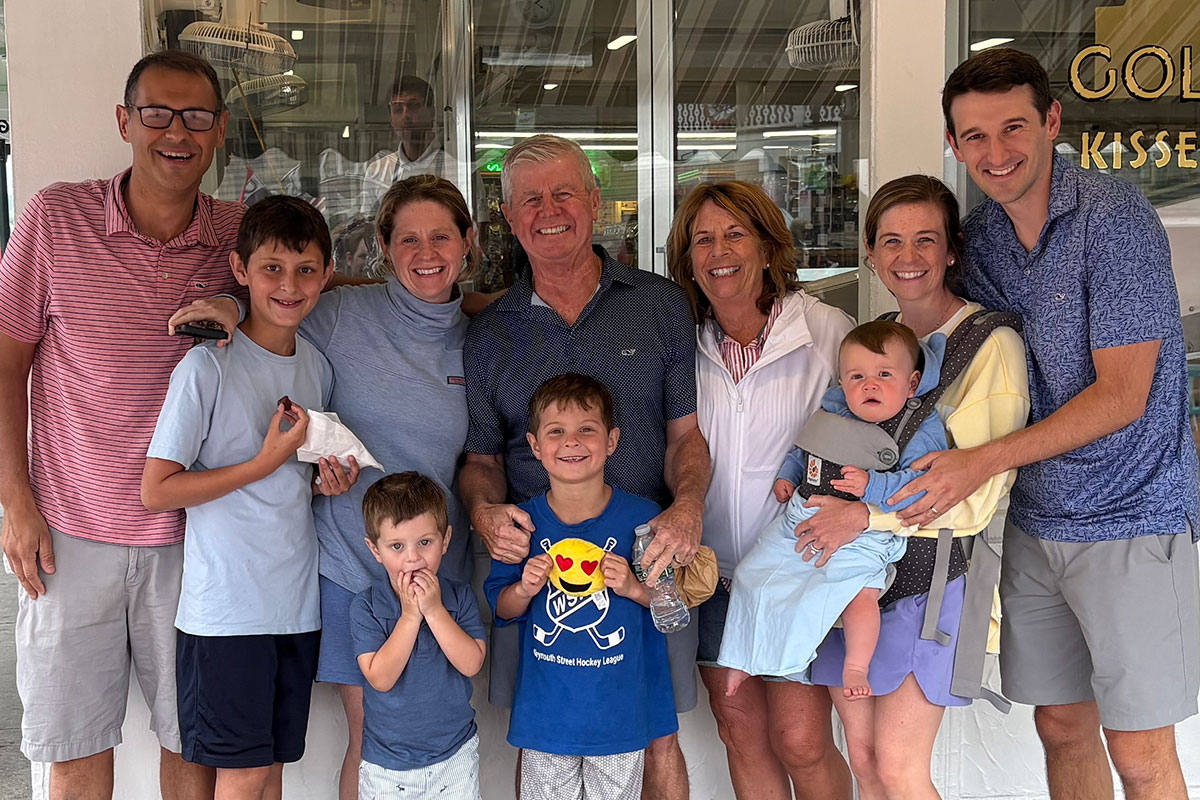
Patient Jim D’Entremont enjoys a delayed vacation with his family.
Combining powerful new RAS inhibitors with chemotherapy has enabled researchers to stop the spread of pancreatic cancer by attacking more than one cellular pathway.
Jim D'Entremont, 66, a business owner in Weymouth, Massachusetts, started taking the breakthrough-drug daraxonrasib, plus a six-month course of chemotherapy, a year ago as part of a clinical trial for pancreatic cancer at the Dana-Farber Cancer Institute. First chalking up his symptoms to kidney stones, D’Entremont was devastated to get his diagnosis and learn that the cancer had spread to his liver.
After six months on the regimen, however, the tumor on his pancreas had shrunk by 25% and the liver tumor decreased by 50%. The liver tumor was then surgically removed.
“The way the trial drug is supposed to work is to deactivate the cancer or put it to sleep,” he says.
D’Entremont says that going through chemotherapy was particularly rough, while his chief complaint from the daraxonrasib was a severe rash. “It looked like I got stung by 200 bees on my chest,” he says. Fortunately, the acne drug Accutane helped him tame the cancer drug’s side effects.
D’Entremont, still on daraxonrasib, continues to contend with minor gastrointestinal distress and occasional fevers, but felt well enough to take a postponed two-week cruise with his family in July 2026 — a trip he didn’t think he would be able to make.
“You have to have the attitude that you can beat anything despite the odds, and that’s how I feel,” he says.