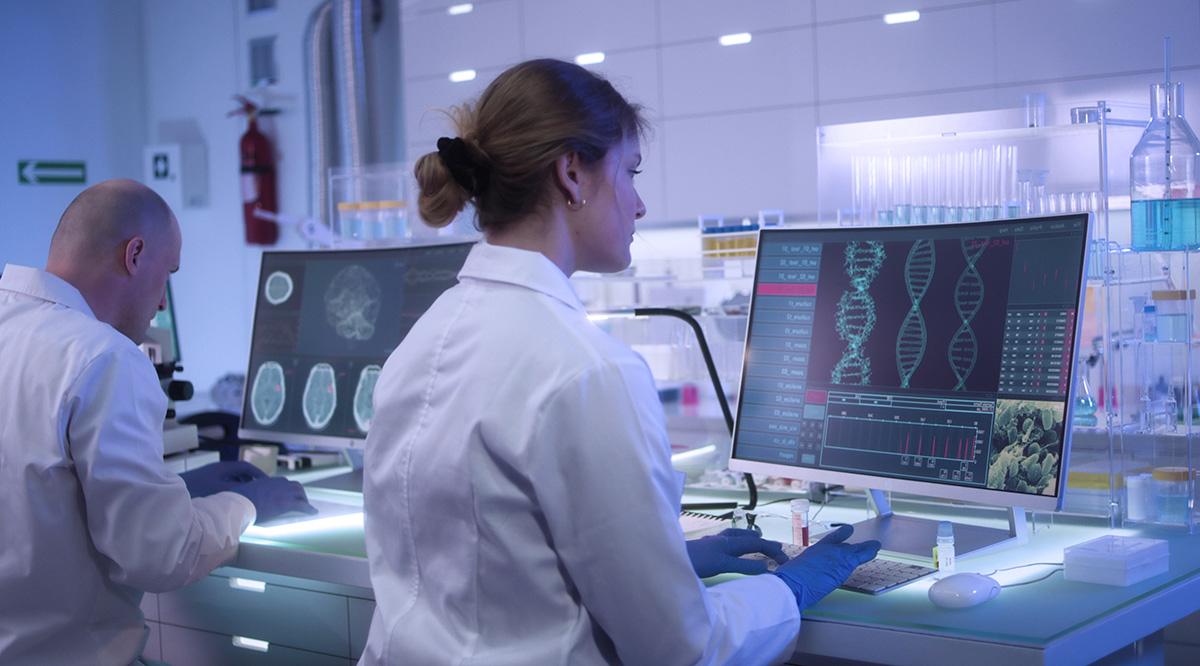
In research labs at Harvard Medical School (HMS), artificial intelligence (AI) isn’t just a piece of technology that scientists tap into for help with a project. Rather, many of them see AI as a partner in planning, carrying out, and accelerating their research.
“They serve as collaborators,” Marinka Zitnik, PhD, says of AI tools used in the Zitnik Lab at HMS, in Boston. “Sometimes we refer to them as co-scientists because they perform science alongside human researchers, by helping them carry out tasks and analysis, like reading study results, synthesizing scientific literature, and analyzing biological data.”
A small but growing number of lab researchers at medical schools are increasingly employing AI in these ways and more, such as assessing the effect of treatments on human tissue samples, helping to predict how patients with certain characteristics will respond to a drug, and providing feedback on scientific hypotheses based on past research. A survey of biomedical researchers by Ithaka S+R (a nonprofit research organization focused on higher education) in late 2024 found that 63% had tried generative AI for work — a figure that has probably risen since then.
“It’s allowed us to brainstorm, to be visionary,” based on the many questions that AI can quickly answer by analyzing datasets, previous experiments, and biological samples, says Carolyn Glass, MD, PhD, principal investigator at the Carolyn Glass Lab at the Duke University School of Medicine (DUSOM), in North Carolina.
Like people in many professions, however, medical scientists are testing the potential of AI with caution. The 2024 Ithaka S+R survey found that only 7% used AI regularly at that time, most often for such basic tasks as drafting text, editing, and searching scholarly literature. The biggest barriers to greater adoption of AI by scientists, according to the report, “are concerns about the accuracy of generative AI and a lack of clarity about best practices for using AI effectively and ethically.”
“[Scientists] are experimenting to see what works, where it can help speed the workflow or give you a new look at data,” says Daniel Raftery, PhD, director of Northwest Metabolomics Research Center at the University of Washington School of Medicine (UWSOM).
Many scientists start with publicly available AI tools, such as chatbots, for basic searches of existing data and literature. But “having a chatbot is not enough for medical research,” Zitnik says. She notes that a chatbot retrieves information from the internet, and “there are lots of things on the internet that are not to be trusted. And there are lots of datasets and insights that are biologically relevant, medically relevant, that are not on the internet.”
A growing number of researchers are building customized AI agents that perform specific tasks and connect to scientific data, computational tools, and laboratory workflows that are beyond the reach of most chatbots.
“You can chat with them, similarly as with a chatbot, but the system will not just retrieve information from the internet,” Zitnik says of a customized AI agent. “It can also analyze data, write Python code [a programming script]. It can retrieve and analyze patient information” that the institution has access to (within privacy regulations). “It can retrieve information from vetted clinical resources such as Food and Drug Administration [FDA] regulatory documents or clinical guidelines.”
“The potential is exciting,” says Hai-Quan Mao, PhD, director of the Institute for NanoBioTechnology at Johns Hopkins University (JHU), in Maryland, which brings together researchers from several JHU schools, including medicine and engineering. “It takes us beyond our traditional expertise and limitations.”
Below are several ways that labs at some academic health systems use AI to increase speed and improve outcomes.
Designing studies: “What would happen if?” is a core question of medical research. It often focuses on the impact of a treatment or a change in a patient’s condition. AI helps scientists answer those questions with greater speed and more information than was possible before.
To get started, some scientists use AI tools to explore topics and hypotheses that might be suitable for an experiment.
“I’ve used it to generate research ideas,” Raftery says. “Sometimes [the ideas] are off the mark, but sometimes there’s a seed of an idea there, based on the prior literature and [other information], that I just hadn’t seen or thought of or didn’t search for.”
Digging further into a project, the tools may provide feedback to help design and refine research in directions that appear to be the most viable. Raftery notes that AI tools can search literature and studies to produce information about designs that have been tried for similar treatments or diseases, the variables of each experiment (such as the patient population), and the outcomes.
“If you have 10 variables you want to examine, you don’t need to do 100 experiments” to determine which approach might yield the most useful results based on various combinations of variables, Raftery says. AI can “help pinpoint the experiments you really need to do, help you come up with a better experimental design so you don’t waste time.”
Predicting results: Taking those analyses a step further, AI agents are helping to predict how a treatment might affect a real-world population. One example comes from the Zitnik Lab at HMS. Scientists there, working with the University of Oxford and the Broad Institute (a disease research organization in Massachusetts) created an agent named ATHENA, which performs what Zitnik calls treatment reasoning. Given complex information about thousands of patient cases (including medical conditions and treatment history), the agent is asked to assess the likely responses (including adverse events) to specific treatments. ATHENA looks up vast amounts of data, including about diseases, patient cohorts, and all drugs developed by the FDA since 1939. It did the latter by sending an application programming interface (known as an API) message to an FDA system, requesting the information, which the FDA system sent.
ATHENA then predicts results for certain treatments in patient populations that might not have been precisely studied before. In one case, Zitnik says, ATHENA predicted that patients with a certain disease and a specific medication history would be at higher risk for an adverse event if they were on an ACE inhibitor to control blood pressure. The lab used electronic health records to find out if, in the real world, patients with that history were reporting the adverse event at a higher rate than would be expected in the general population. They were.
“We are seeing examples of how AI scientists can help generate outputs that provide useful insights that can steer experiments in the lab, can steer the work of clinical researchers who might be designing clinical trials, or nominate new drugs that might be effective for a specific patient,” Zitnik says.
“The analytics are amazing in terms of predicting future events,” says Dushyant Sahani, MD, chair of the Department of Radiology at UWSOM. “Now we can look at metadata from 10,000 patients. But [we can] also look at parsing out the data into various sub-analyses” of cohorts — such as specific ethnicities, genders, and diseases — to help guide future courses of action.
Assisting with lab tasks: One of the common burdens that medical scientists bemoan is the amount of routine, repetitive work that doesn’t take enormous brainpower or creativity, but soaks up a lot of time. Yet the work, largely administrative, is necessary.
To help remedy that, scientists and student researchers in many labs employ AI tools the same way they might take on an assistant to carry out such tasks as building workflow management, maintaining a to-do list, consolidating basic findings from literature searches, and drafting reports about the lab’s work.
“The models are being used to make everyday work more efficient, or to perform tasks that might be somewhat mundane or routine,” Zitnik says. She uses AI agents for many such tasks, including “helping me follow up with various collaborators, editorial offices, or research offices in terms of what needs to be done” to move forward on various projects.
On a more advanced level, lab leaders envision AI agents working more directly with robots to run various tasks on their own, with human oversight. This could include preparing, analyzing, and recording the results of thousands of biological samples, and making decisions about what sampling and testing the robot should do next without direct instructions from humans.
“It’s possible to envision an entire lab with robotic systems running experiments continuously,” Mao says. “Students and researchers can establish the experimental framework, define the decision criteria, and oversee the results.”
The human role
Officials at academic health systems that are ramping up their use of AI routinely stress the need to keep “humans in the loop.” One reason is to validate the technology’s methods and results.
“We have to be rigorous in terms of evaluating the outcome that AI provides,” Mao says. “There has to be a check, a validation, because you cannot just simply trust whatever AI is telling you.”
One strategy, Mao says, is for researchers to experimentally test AI-generated predictions or recommendations “to confirm that the AI interpretation is reliable.”
Another, says Glass at DUSOM, is for the labs to establish “governance and guardrails” on how AI is used, “to make sure that it’s doing what it should be doing.”
Scientists also stress the need for human involvement in experiments, to maintain the kind of judgment and creative insights that humans uniquely contribute.
“This kind of research still relies heavily on our intuition,” Mao says. “Scientists remain responsible for defining the important questions and weighing which ideas to pursue. [AI] frees up the scientist and students to do more creative thinking.”