
“What are new things I need to learn? And what are old things I don’t need to learn?”
Those are among the key questions for medical students (and their teachers) as the breakneck progress of artificial intelligence (AI) transforms education, says Robert Wachter, MD, chair of the Department of Medicine at the University of California, San Francisco, and author of A Giant Leap: How AI Is Transforming Healthcare and What That Means for Our Future.
Wachter will participate in a discussion at Learn Serve Lead 2026: The AAMC Annual Meeting, about how medical schools and health systems can harness the technology’s potential while preserving the critical thinking, ethical reasoning, and human judgment that are essential to developing tomorrow’s doctors. He will be joined by Karan Singhal, OpenAI Health AI lead, and Marc Triola, MD, senior associate dean for medical education at NYU Grossman School of Medicine. They will examine the role of productive “friction” in learning, the risks of “de-skilling” or “never-skilling” among students who over-rely on AI, and how partnerships between academic medicine and technology organizations can help prepare learners.
Wachter’s book lays out a framework for evaluating AI tools in academic medicine, stating that these tools will be beneficial despite flaws that must be addressed. He writes that AI can consistently produce results that outperform the status quo in a system strained by bureaucracy, cost pressures, and clinician burnout. In Wachter’s view, AI can give physicians more time and information to exercise their expert judgment and connect on a personal level with patients.
Wachter recently spoke with AAMCNews about the impact of this technology on medical education. Below are excerpts from the conversation.
This interview has been edited for brevity and clarity.
How should medical schools prepare students to become physicians when the role of the physician is being so impacted by AI?
The technology is extraordinary, and the needs of the health care system are daunting — and I would say unmeetable — without AI.
Nobody really knows what the life of a physician is going to be like 30 years from now, which is essentially what a medical student is making a bet on. Given that, we need to sort out new competencies for the AI age. Just as importantly, we need to identify legacy competencies that are no longer relevant, or worth the time and effort.
As for new things students need to learn, trainees will need to be comfortable with AI tools: to understand what they can and can’t do, how to interact effectively with them, and which tools to use in various circumstances. And they need to learn about change management. That means learning to be flexible in the face of change, to recognize that things will change in many ways for the better.
The hardest question is what to remove from the curriculum, partly to make room for these new competencies. While knowing that it’s critical to ask a dyspneic patient if they have noticed leg swelling, I don’t think students will need to know the mechanisms of 10 different seizure drugs. Do they need to have memorized the Krebs cycle? I believe the answer is no. But does a student need to remain expert in diagnosis and diagnostic reasoning? The answer is yes, at least for now.
What are some of the best uses of AI for students?
Students can use AI for coaching. Take a student walking into a patient’s room to have an end-of-life discussion. That’s very scary for a student to do the first time. You can pick up one of these tools [and say], “I’m about to walk into this room with this patient with widely metastatic lung cancer to ask whether he wants to be resuscitated if his heart stops. Can you coach me on that?”
What’s an example of how AI can expand possibilities for students and their teachers?
There are things that AI can do that could provide massive educational opportunities. For example, as a ward attending physician, I need to render judgment on a student’s interviewing skills. But, since I usually don’t have the time to watch the interview, I use an imperfect proxy measure: the student’s presentation of the case on rounds. But AI does have the time. Imagine that, with the patient’s permission, the student recorded the conversation, and the AI gave the student feedback on their interviewing technique. That would be a major advance over the status quo.
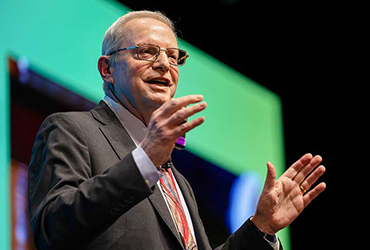
Wachter giving the keynote address at the American Thoracic Society (ATS) International Conference in Orlando, Fla.
Photo courtesy of ATS
Are there cases where students should not use AI or should postpone its use?
Do we turn on AI scribes and chart summarization during patient visits? Do we permit or encourage students to have OpenEvidence or other AI tools spoon-feed them differential diagnoses? These tools are useful and getting better. But if you become dependent on a tool to outsource your thinking, you’re going to become dumber.
Giving a student access to that tool on day one probably bypasses some important educational friction. The neural pathways that must be developed as a student goes from talking to a patient to writing a note on their own and figuring out how to organize it.
We’ve come to recognize that the decision you might make for the practicing doctor on the use of AI might be the wrong decision for a trainee. They need to learn how to write a note before you turn on a scribe for them. They need to develop their own differential diagnosis before the AI presents it to them.
How do we get around that?
I would prefer that we develop AI tools that don’t give trainees the answer, but instead require that they tell the AI what they think the answer is. Only then should the AI critique the answer in a way that raises the probability that they will stay engaged and learn, as opposed to just using the tool as a crutch.
In the old days, when I typed my notes, sometimes it would jog my thinking: “Oh, I forgot to ask about X or Y.” Just giving trainees the tool that a professional can use well, and bypassing all the foundational layers that people of my vintage went through, is risky. These tools are now good enough to be useful, and not perfect enough to be entirely trusted.
Humans should have the foundational skills. I believe that professionals need to be decent at the skill in the absence of the AI in order to be effective when partnering with the technology.
How does this challenge teachers in assessing the competencies of students?
We are, as the cliché goes, building the plane while we’re flying it.
What do we want to know that the student can do in the absence of AI? I would like to know the competency of humans to do things without AI. That’s old school. Then layer in AI, gradually give them permission to use it as a copilot.
We may have times when we’re teaching students content that they can get from AI, and the students will roll their eyes and say, “Why do I have to learn this thing?” We’ll have to say something that’s wildly dissatisfying to students: “Eat your spinach, this is good for you.”
You write and talk about de-skilling. Is there a risk of students never-skilling — that is, not learning what they should learn?
Many students are quite sensitive to this idea of never-skilling or de-skilling, and are worried about it. One student said to me, “I’m going to be an AI vegan.” I’m pleased to see that some students are sensitive to the risk of never-skilling, but we can’t depend on this as our only strategy.
For example, to ensure that clinicians maintain their skills, we might need to turn off the AI tools periodically or program the AI to, from time to time, ask a clinician to put their nickel down — that is, provide his or her own medical opinion — before offering an answer itself.
Speaking of easier: You write that many medical school application essays are written with the help of AI and are assessed with the help of AI. Should medical schools get rid of the application essay?
Asking a student what they care about and how they would describe themselves is still useful, even if some of it is being crafted by a tool that they use. In the days before this technology, how did we know that a student didn’t ask her aunt to write their essay? I think the act of writing an essay is still useful, but you can’t judge it anymore by the quality of the exposition. Two different students are going to load into AI different priorities: “I want to talk about my time in the lab” or “I want to talk about my time with my grandfather when he was dying.” Seeing what their priorities are and how they articulate them has some utility for assessing the students.
But nothing feels stable anymore. In virtually every part of medical education, we can’t just do a thing the way we’ve done it for the last hundred years and assume it’s the best way.