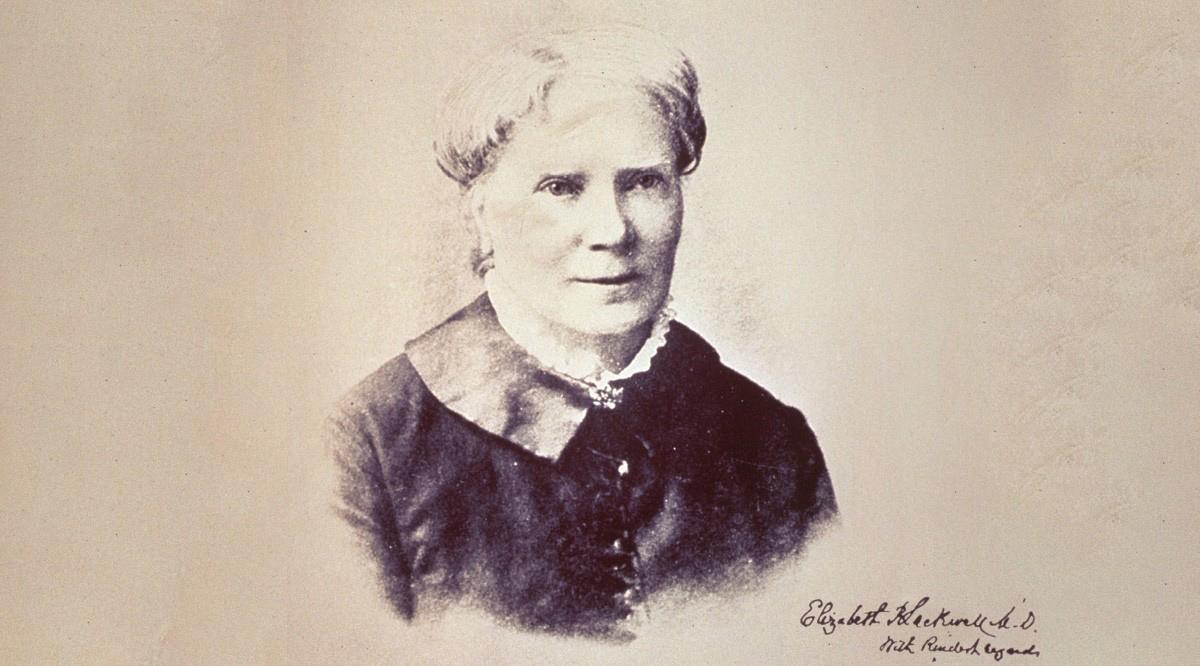
To foretell a time when the majority of medical students would be female was inconceivable in the mid-1800s, when Elizabeth Blackwell enrolled in Geneva Medical College in upstate New York. The first-ever female medical student in the United States, she did not receive her acceptance from a traditional faculty vote. Instead, mischievous male students, anxious to outwit their faculty, voted unanimously to accept her. Blackwell herself may have realized her presence would be met with some skepticism, as her acceptance letter had been sent not by the academic dean but by T.J. Stratton, chairman of the student body, who pledged that no conduct of “the students shall cause her to regret her attendance.”
While her classmates eventually came to respect her, the public was not as kind, chiding her for daring to go beyond any of the socially circumscribed roles of women into a world traditionally reserved for men. The medical establishment also grumbled discontent. The Boston Medical and Surgical Journal (the precursor to The New England Journal of Medicine) called her graduation in 1849 a “farce.” The local paper, The Geneva Gazette, was more courteous. “As her name was called, Elizabeth Blackwell, MD, passed easily and gracefully upon the stage. It was a scene for a painter, A Lady Alone.”
In 1993, during a college tour with my elder son to Hobart and William Smith Colleges in upstate New York — which houses the Elizabeth Blackwell archives — I began looking into Blackwell’s history. I continued my research at the Geneva Historical Society, the Library of Congress, and the American Antiquarian Society. A highlight was meeting John Blackwell, a grandnephew of Elizabeth Blackwell, who introduced me to the Boston Athenaeum and recommended I visit the Schlesinger Library at the Harvard Radcliffe Institute, which houses a trove of Blackwell papers. A desire to present Blackwell’s extraordinary life in a bold and dramatic way, just as she lived it, led to A Lady Alone, my one-woman play about the life of Elizabeth Blackwell, a feisty woman who faced strong headwinds while bringing her vision and energy to what she believed to be right.
A historic journey begins
After graduation and seeking advanced postgraduate clinical training — at the time, graduate medical education was not required of physicians — Blackwell applied for hospital positions in England and France. Rebuffed by most of those hospitals, which were unacquainted with women physicians, she received her only success from La Maternité in Paris, a training site for midwives, where she mainly cared for women and their babies. It was while caring for a newborn with gonorrhea that Blackwell’s left eye became infected, subsequently requiring enucleation. And so her dream of becoming a surgeon was thwarted.
Upon returning to New York City after her clinical training, Blackwell found establishing a practice difficult. Most Manhattan landlords resisted renting space to a woman physician, fearing she might be an abortionist, and families were hesitant to seek care from her. Hoping to attract patients, Blackwell began hosting a series of lectures on what we now call the social determinants of health: poverty, crowded living conditions, poor sanitation, and inadequate nutrition — and their impact on health. Wishing to educate the impoverished women in the neighborhood, Blackwell boldly suggested ways to prevent multiple pregnancies. Male colleagues, already displeased with a woman entering the profession, were enraged by her outspoken lectures.
As her practice expanded, she opened the New York Infirmary for Indigent Women and Children with her sister Emily Blackwell, who had followed her into medicine, graduating in 1854 from Cleveland Medical College. Since women had difficulty gaining acceptance into primarily male medical schools, the Blackwell sisters and Maria Zakrzewska, a Polish midwife who attended medical school at Case Western Reserve University, launched the Women’s Medical College of the New York Infirmary in 1868. The success would be threefold: Indigent women would have a local hospital, women physicians would have a place to practice, and medical students and residents would have a quality education.
Thirty years later, in 1899, heartened by the increasing number of female medical students enrolled in medical schools heretofore open only to men, the Blackwells shuttered their medical college, transferring the remaining students to Cornell University Medical College. But the timing was premature. The Flexner Report of 1910, commissioned by the Carnegie Foundation for the Advancement of Teaching, led to significant reforms in medical education but also resulted in the closure of multiple medical schools, including many that admitted women and Black students. Not until the mid-1970s would a reversal begin, as a trickle of women matriculants began the march to our present day, when women make up more than 50% of all medical students.
As Blackwell was an abolitionist, like her father and Quaker forebears, it was only natural for her to step forward at the onset of the Civil War. Acknowledging that women physicians were unwelcome in the military, she prepared women to be nurses for the Union Army. She also became a prime advocate for the Women’s Central Association of Relief (WCAR), an organization designed to set up a central depot for hospital supplies, register and examine volunteer nurses, and interact with the Army. The WCAR became the cornerstone of the United States Sanitary Commission, the private relief agency officially sanctioned by President Lincoln, in 1861, to support sick and wounded soldiers.
An activist, Blackwell was not only committed to expanding opportunities for women in the medical profession, but also voiced her opposition to societal and medical practices that affected the health and well-being of women and children. At the request of female-physician colleagues, Blackwell appeared before the American Medical Association to call for an abandonment of reckless gynecological surgical procedures, including clitoridectomies. The reason for the surgeries was both irrational and unethical, as husbands and male physicians labeled these patients as oversexed or “hysterical.”
International impact
Committed to advancing women’s health and women in the medical profession on both sides of the Atlantic, Blackwell traveled back and forth between the United States and Great Britain, becoming the first woman on the British Medical Register. But her unwavering opinions on the role of women in medicine clashed with those of her British friend Florence Nightingale, the highly esteemed leader in nursing. As tensions rose, Blackwell found herself practicing mostly in the United States.
But British women anxious to replicate medical education for women persuaded Blackwell to return to England, which she did in 1869, accompanied by Kitty Barry, whom she had rescued as an orphan from the House of Refuge on New York City’s Randall’s Island in 1855. Blackwell lived out the remainder of her years in Scotland with Kitty. She died in 1910.
As we look back on the life of Elizabeth Blackwell, we see that many of the controversies she took on during her time — the poor health of women due to social determinants of health and the challenges faced by women physicians, to list only two — have resurfaced today. At the turn of the century, Blackwell became an outspoken proponent of the anti-vivisectionist movement in both England and the United States, even admonishing her sister Emily not to teach vivisection at the New York Infirmary medical school.
Not all of Blackwell’s ideas conform with modern understanding of evidence-based practice, though. When the British Parliament passed a series of Compulsory Vaccination Acts, requiring childhood vaccines under penalty of jail sentencing, parents started an Anti-Compulsory Vaccination League. Distressed by the death of one of her patients after a smallpox inoculation, Blackwell took a firm stand against vaccination.
And while reformist women of the time championed women’s rights, Blackwell scorned the women’s movement sparked by Susan B. Anthony and Elizabeth Cady Stanton. Despite the urging of her sister-in-law Lucy Stone, a prominent leader in women’s rights, Blackwell declined to become involved in the broad agenda of women’s issues and rejected an invitation to speak at the First Women’s Rights Convention in Worcester, Massachusetts. Her role, she felt, was in championing the health and well-being of women and babies — and the rights of women to become physicians to care for them.
Today we celebrate Blackwell’s courage and foresight, and acknowledge her role in inspiring generations of women physicians, while recognizing that we have much work to do.