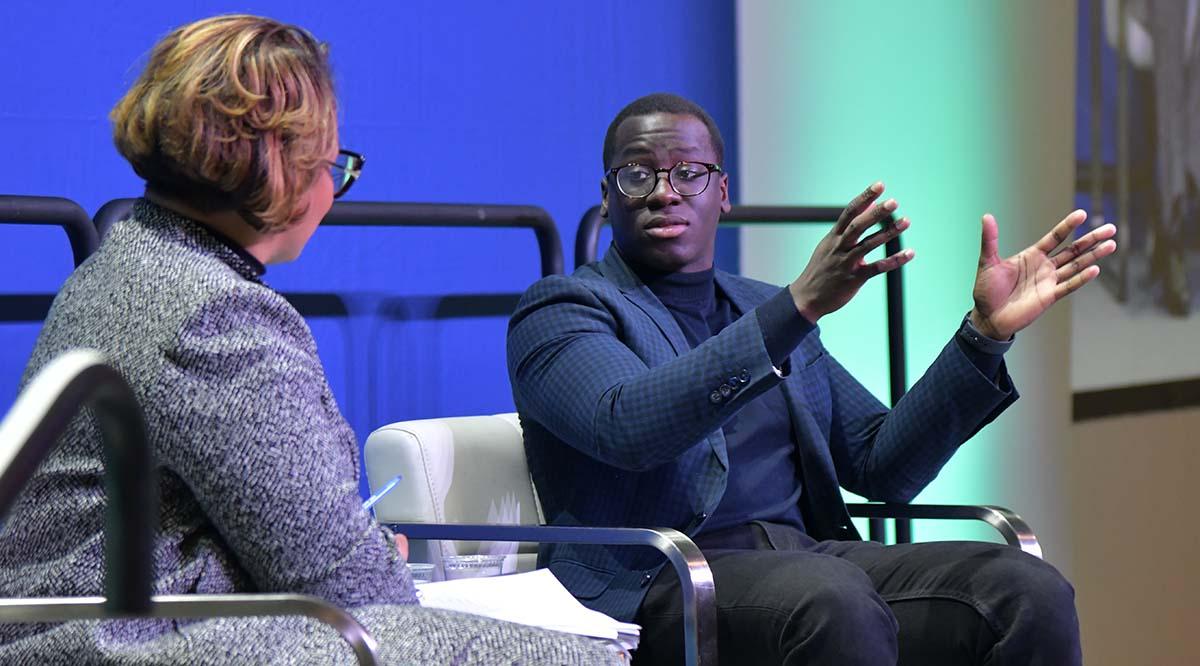
For Joel Bervell, MD, improving health starts with meeting people where they are — online.
With more than 2 million followers across his social media channels and with a reach of 15 million viewers each month, Bervell has taken on the challenge of addressing medical misinformation and inequity in medicine by making his messages accessible to the masses.
“Social media is the new town hall,” says Bervell, who, in addition to making his Peabody award-winning social media videos, hosts The Dose, a podcast by the Commonwealth Fund, and The Doctor Is In, an animated YouTube children’s series that teaches about medicine. Plus, he’s a second-year internal medicine resident at Virginia Mason Franciscan Health at Saint Joseph Medical Center in Tacoma, Washington.
Bervell will join Nadine Burke Harris, MD, MPH, FAAP, a pediatrician, researcher, and California’s first surgeon general, and Kelly Corrigan, a best-selling author and the host of the Kelly Corrigan Wonders podcast, onstage at Learn Serve Lead (LSL) 2026: The AAMC Annual Meeting, for a plenary session on Sunday, Nov. 8, in Anaheim, California.
In the session, entitled Keeping What Really Matters at the Forefront of Academic Medicine, the speakers will discuss how to preserve academic medicine's meaning in uncertain times and how to reaffirm the human practices and values that are foundational to medicine, despite disruptive technology and health care worker burnout.
AAMCNews spoke with Bervell about dispelling myths, building trust, and supporting health care workers through times of challenge.
What are some of the big challenges academic medicine is facing as you’re starting your career, and how can the medical community begin to face them?
I think there are so many challenges right now. One of the big things that’s top of mind for me is misinformation, disinformation, and how information gets spread to different populations. With the advent of social media, the entire way that information is given out has drastically changed. And, unfortunately, many people get their information online from inaccurate sources, which makes it more difficult within the health care system to: one, build trust with patients who don’t have medical knowledge; and two, it also just makes it more difficult for us to do our job to keep the public healthy. Obviously, I’m using social media to disseminate health information, but there are a lot of different ways that people are trying to build trust with different communities.
Another big thing I’m thinking about is the increasing privatization of health care. Private equity has been getting into health care systems more and going into [the business of] emergency departments. Unfortunately, this is resulting in closures of needed health services in areas that have fewer resources.
And another thing I always think about is how we think about health equity in medicine, especially in a landscape where diversity, equity, and inclusion is now a [phrase] that often is used as a pejorative. But if we really want to have a health care system that treats everyone equally, it really needs to focus on understanding people of different backgrounds, training diverse doctors, getting them into underserved locations and into rural areas, using different technology, like telemedicine, using AI — that’s a whole other conversation there. I think about how AI can be used as well for all these things.
These issues can all be connected to the element of human connection and the relationship between the doctor and the patient, and between the health care system and the communities it serves. How has that connection between doctors and patients changed, and what role do you think human connection should have in medicine?
I love that question so much because I think about this all the time. The first catch is that the doctor-patient relationship is inherently imbalanced. So, the fact that the provider knows more about health care, but then a patient knows more about their health, and that we control, in some aspects, their access to the health care system, makes us gatekeepers. Recognizing that is always important, because it shows that even where trust begins isn’t equal.
I think one of the biggest changes, if you look over the past century in health care, has been moving from a relationship between a doctor and a patient to relationships between communities and entire health systems. While our systems have become more sophisticated, they’re not always more human. So, historically, for example, physicians used to be known to generations [of the same family] or they went into homes. But today, with more technology, specialized care, data-driven medicine, all of that right now, patients often feel like they’re navigating a maze rather than a relationship.
If I could go back to a time, it’d be beautiful to go back to when doctors made house calls, because that was where you really saw where someone lived, what their structure looked like in their life. You really got to learn so much about them beyond just their health problems, by seeing their actual lived environments. What we’ve learned is that health doesn’t begin in the hospital. It begins in our homes, in schools, in workplaces, in neighborhoods, everywhere. And so, trust is built way before someone enters into an exam room. If a community isn’t able to trust the health care system, it doesn’t matter how advanced our treatments are. If people don’t want to actually use [a treatment], it’s not going to do anything.
As physicians, our role is no longer just to treat disease. It has to be so much more than that. It has to be building trust. It has to be strengthening relationships with individuals. It has to be serving as a connector between this increasingly complex health care system and these communities that we’re serving.
And the last thing I'll say around that idea of trust is that there’s also a history of mistrust from specific communities. Black and brown communities, people who have overweight and obesity, people who come from rural communities, all these communities have good reason not to trust the health care system. If you look back at different experiments like the Tuskegee syphilis experiment, or you think of Henrietta Lacks, these are cases cited for why specific communities don’t trust the health care system. But it goes so much deeper than that, in the sense that many people of color have had experiences where they felt dismissed or not believed by the health care system. It’s a common experience that shapes how communities think about medical care. And so, it’s really important to understand that trust has been lost in our health care system, maybe not in us as individuals, but in the system overall, and to think about how we are going to be a part of actually rebuilding trust.
Has there been progress in rebuilding that trust?
What is encouraging is that we are seeing some conversations evolve into action. I’ve seen, specifically, health systems that are investing in community partnerships and really having the conversation about how inequity is built. You look at places like the New England Journal of Medicine, which is thought about as the bastion of academic research, and how, right now, they’re doing an entire series called “Intention to Treat,” where they go through their old journals and are doing a reckoning and talking about the ways that their own journals perpetuated biases or lost trust from different communities. There are researchers who are really thinking about clinical trials and making them more diverse. Medical schools are popping up, even my own medical school, Washington State University [Elson S. Floyd College of Medicine, in Spokane], was built around the idea of regaining the trust of communities. Before, we had only one medical school in Washington state, and we weren’t reaching so many different communities. So, medical schools are thinking more deeply about social drivers of health, where you’re trying to get people from different backgrounds into the health care field so they stay within their communities.
Even technology developers are trying to think about the tools that they’re working on for all populations. For example, pulse oximeters, which can be less accurate in people with darker skin tones and may overestimate oxygen saturation — there are so many people thinking about how we can actually fix this.
Still, with the current legal and regulatory environment and pushback on diversity, equity, and inclusion, many institutions that want to do the work it would take to rebuild trust in underserved communities are at a standstill.
You’ve also spoken about burnout and mental health for health care workers and, especially, doctors. Where are we as a medical community with supporting health care workers, and where can that be done better?
For a long time, burnout was considered an individual problem. People were treated as if they were the problem, that they needed to be more resilient or do more self-care. But what is being seen through research is that burnout is a systems problem. It’s a symptom of a broader system that’s challenging individuals. And physicians, today, are navigating way more complex territories than they were before. We’re caring for sicker patients now that have more complex metabolic diseases. Because of that we’re operating in a more intense environment and expected to know and do more with more limited resources and more oversight that is not actually making things better. I was just on Capitol Hill in Washington, D.C., a few weeks ago, advocating for funding mental health services for health care providers through the Lorna Breen Act [named for an emergency physician who died by suicide during the COVID-19 pandemic]. There are bills and policies that are out there right now that are trying to address the problems, but once again, it can’t just be on the individual doctor. Ultimately, it has to be the system that really looks at itself. And when a health care system supports its workforce, it’s better able to support patients and communities.
What will be your main message for the attendees at Learn Serve Lead?
One thing I’ve learned throughout my own career is that every person in medicine has more influence than they realize. If you’re a student, you have the power to question and challenge assumptions as you go into training, because you have a front-row seat to the way you are getting trained. If you’re a resident, you get to shape the culture that younger trainees experience, and what you’re even going through at that time. And if you’re faculty, you get to model what medicine looks like for future generations. If you’re a dean or a health systems leader, you get to help determine the structures and incentives that define how care is delivered. So, what I really want to leave people with is that the future of medicine will not be determined by a single breakthrough or individual policies. It’s determined every single day, by each and every one of us, in the thousands of decisions that prioritize who gets listened to, whom we include, what we prioritize, and when we choose to start making change in a system. My hope is that we leave LSL really recognizing that the goal isn’t simply to create better doctors; it’s to create a health care system that’s worthy of the trust that patients deserve and sustainable for the people who work in it.