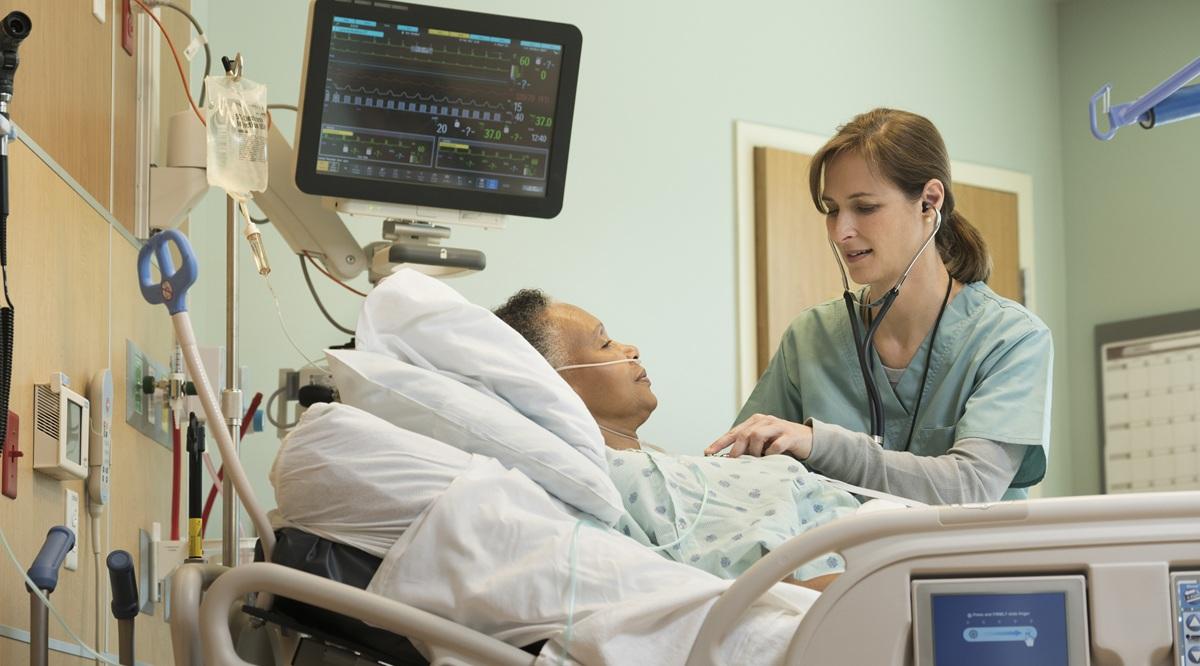
At the start of the conversation with her doctor, the patient seemed to be recovering quite well in the intensive care unit (ICU). She was alert and spoke clearly, recalls Babar Khan, MD, a professor of medicine at the Indiana University School of Medicine: “I thought, ‘This looks good, her orientation is good, she’s paying attention to me.’”
Then the patient mentioned all the little people running around the room.
“Look at these small people,” she said. Khan asked for more information. “They don’t harass me, but they climb the walls,” she explained. “I don’t know why you guys have them.”
Khan recognized that the woman was experiencing ICU delirium, a common form of brain dysfunction that can include confusion, fluctuations in attention and awareness, paranoia, and, in extreme cases, hallucinations and violence. While forms of delirium occur in many hospitalized patients, it is especially common for those who have been on ventilators and/or heavily sedated; not surprisingly, studies have found that this delirium is particularly prevalent in the ICU.
For decades ICU delirium was seen as an inevitability, to be managed by ensuring that patients didn’t hurt themselves or someone else. Almost one-quarter of ICU patients develop delirium, according to a study published in the International Journal of Scientific Research in 2025.
The malady gradually came to be seen as hampering patients’ recovery and was associated with long-term cognitive impairment and early death. A cohort study of 9,600 patients, published last year in the journal BMC Neurology, concluded that “patients who developed ICU-delirium had a reduced survival up to four years after ICU discharge,” and that the association was especially evident in patients over age 55.
“It’s not just a short-term problem,” says Joanna Stollings, PharmD, clinical pharmacy specialist in the Medical ICU at Vanderbilt University Medical Center (VUMC), where she researches critical care, delirium, and ICU recovery.
More and more academic health systems have implemented strategies in recent years to forestall the condition or mitigate its harm, largely through changes around sedation, mechanical ventilation, and patient mobility.
“I noticed that many of my [ICU] patients were not reachable,” says E. Wesley Ely, MD, MPH, who has led the development of intervention strategies and is founding codirector of the Critical Illness, Brain Dysfunction and Survivorship (CIBS) Center at VUMC. “I couldn’t reach them. I wanted to reach them.”
Ely, Stollings, and Khan are among many physicians and medical researchers who have seen those strategies work, from both observations of individual patients and studies of several thousand. A meta-analysis of eight studies that included more than 4,700 patients, published by the International Journal of Nursing Studies in 2022, found that the most commonly used tool (the ICU Liberation Bundle, also known as the ABCDEF bundle, for its alphabetized steps) reduced the onset and duration of ICU delirium.
However, while many hospitals report they use ABCDEF or another set of strategies, studies have found significant challenges to full implementation, including staff time and the need for just about everyone who treats an ICU patient to get fully on board.
“It is a lot of work on the staff, and unless you’ve changed the whole culture of the ICU,” the impact will not be as strong as it could be, Khan says.
Managing delirium
Let them sleep.
For many years that was a standard way for ICU staff to respond to patients who are, in commonplace parlance, “out of it.”
“We thought it was humane,” Stollings says. “You were letting them rest.”
The problem, she notes, is that “in the letting the patients sleep, we were harming them, because they spent more time on the ventilator, in the ICU, and in the hospital.
“Also, the patient may have hypoactive delirium” — typified by lethargy, sleepiness, and unresponsiveness — “which means that you won’t know they have delirium without using a validated assessment tool. If you don’t try to wake them up, you can’t ask them questions such as, ‘Where are you?’”
On the other end of the spectrum are those who are hyperactive.
“The patients are out of whack. They’re agitated, they’re pulling things [such as tubes], they’re upset,” Khan says. The ICU staff sees that “there are multiple reasons for them to be upset. They have a tube down their mouth, they’re restrained, they are sick.”
Another challenge is that the causes and signs of ICU delirium can cover just about everything that lands someone in the ICU. Articles have cited a combination of a patient’s attributes — including overall health, age, and immediate medical condition — as well as the ICU environment itself: sedation, sleep disruption, unfamiliar surroundings, discomfort, immobility, sensory deprivation, and noise.
Many hospitals use the CAM-ICU (Confusion Assessment Method for the ICU), a bedside set of questions to assess mental status and attention. The questions typically include “Will a stone float on water?” and statements such as “Hold up this many fingers.”
The implications of missing the diagnosis or insufficiently treating the condition can be severe. “It increases mortality, it increases people’s length of stay in the ICU, it increases their health care costs,” Stollings says. “It can cause dementia.”
Warding off delirium involves taking steps that often run counter to what has been typical in ICUs. These steps strive to nudge patients back to cognition and mobility. They include reducing or eliminating sedation medications, verbally engaging with patients repeatedly, removing ventilation and other devices (such as catheters) that restrict movement, giving patients their eyeglasses and hearing aids, and getting them up on their feet.
“Turn off the sedation, get the person out of the bed, walk them,” Ely says. “It takes personal touch. We want a human being to touch another person’s skin. We want that person to look them in the eyes, we want them to talk to them and encourage them. That's what helps people live.”
“We want people to be awake,” Stollings says. “We want them to return to the land of the living.”
As noted above, the most frequently used tool to support that return is the ABCDEF bundle, from the Society of Critical Care Medicine. The steps are
A: Assess, Prevent, and Manage Pain
B: Both Spontaneous Awakening Trials and Spontaneous Breathing Trials
C: Choice of Analgesia and Sedation
D: Delirium: Assess, Prevent, and Manage
E: Early Mobility and Exercise
F: Family Engagement and Empowerment
Impact and challenges
Studies have indicated that such strategies have some effect. A trial study published in The Lancet in 2008 demonstrated the benefit of pairing spontaneous awakening (stopping sedatives and restarting them as needed) with breathing trials in ventilated patients. A meta-analysis published in 2024, in Critical Care Medicine, found that such measures may reduce the length of stay in ICUs and short-term mortality for some patients. However, the authors noted that the wide variations in how the strategies are carried out, and the low certainty of the evidence in the studies they looked at, limited “our ability to make strong conclusions.”
Implementing these strategies has indeed been a challenge. A study published in the American Journal of Critical Care in 2022 found that even among a group of institutions that committed to implementing the ABCDEF bundle, full implementation topped out at 12%.
“We set up programs that can reduce delirium and can get their [patients’] brains back on track,” Ely says. But, he added, “a lot of sites that say they’re doing it are probably doing it at 10 to 20%” of the recommended steps.
Consistently following the steps requires continuing education of ICU staff, including nurses, physicians, ancillary staff (such as respiratory therapists), and trainees. Carrying out all the elements — such as connecting with patients at the bedside, and getting them up and walking — takes time and teamwork.
“Many ICUs struggle to consistently perform daily delirium screening,” noted an article in Nursing Reports in 2024.
One of the article authors, Biren Kamdar, MD, MBA, of UC San Diego Health, understands the struggle:
“It’s not easy to get them [patients] out of bed. It’s not easy to take off their restraints and minimize drugs that may put them into a semi-sedated state. It’s not easy to have family interact with the patient. It’s not easy to dig out their glasses and hearing aids. These all require extra effort.”
Nevertheless, Kamdar says that implementing the strategies brings “a massive return on investment” for patients and also for caregivers, through “marked improvements in staff morale and confidence in care.”
Overcoming the challenges involves weaving the strategies into the routine checklists of the ICU and the conversations about patients during rounds, and continuously educating all staff whose work affects ICU patients.
At VUMC, Stollings says, ICU nurses “have a specific script that they fill out every morning” for each patient, “and on the left-hand side of that script, it has every letter — the ABCDEF bundle,” which the nurses review on rounds.
Advocates for these measures stress the power of physicians to show the way through visits with and queries about ICU patients.
“When I say at the bedside, ‘This is really important, we need you to let this patient wake up, get them out of the bed, and let’s walk them,’ people pay more attention,” Ely says.
The education — of doctors, nurses, respiratory technicians, and support staff — requires changing the culture of ICU care. For decades, Kamdar notes, success in the ICU meant getting the patient out of the ICU. Now, he says, “it’s not just survival that is at stake.
“Getting them out of the ICU alive is not enough. We have to think about their post-ICU journey.”