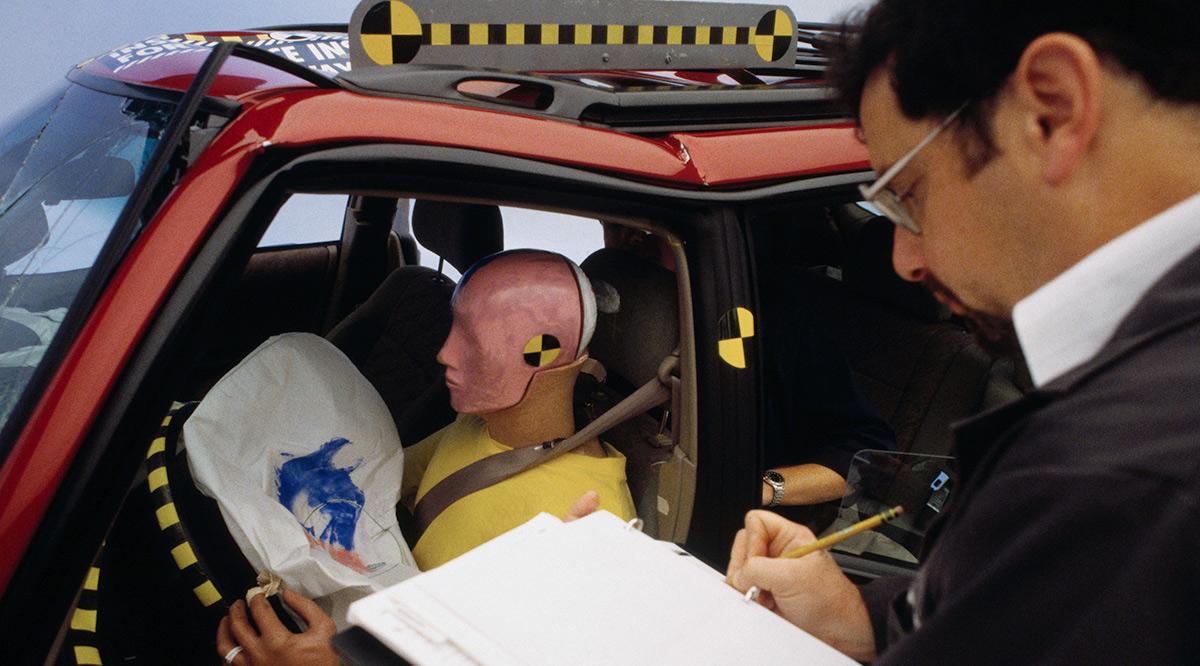
Automobile accidents in the United States accounted for 44,000 deaths, 2.8 million emergency department visits, and nearly half a trillion dollars in costs in 2023, the most recent year with complete data on the subject, according to the Centers for Disease Control and Prevention.
That’s why doctors and researchers at academic health systems across the country are involved in efforts to collect data on crashes and come up with solutions to better prevent them and mitigate the worst outcomes when they happen.
“It’s a public health issue,” says Jonathan Rupp, PhD, director of the Injury Prevention Research Center at Emory University School of Medicine, in Atlanta. “These crashes have a huge effect on morbidity and mortality.”
Emory is one of nine academic institutions in the United States that are part of the Crash Injury Research and Engineering Network (CIREN), which was established by the National Academy of Sciences in 1985 to stem the rapid rise in crash fatalities and injuries. As cars and trucks became the main mode of transportation following the construction of the interstate highway system in the 1950s, fatalities climbed from fewer than 29,000 in 1942 to more than 56,000 in 1972, according to the National Safety Council.
CIREN brings together multidisciplinary teams, including mechanical and biomechanical engineers, trauma surgeons, radiologists, orthopedic surgeons, emergency medicine physicians, first responders, crash investigators, and representatives of the National Highway Traffic Safety Administration (NHTSA), to collect data and use it to make recommendations about vehicle design and emergency response.
“It’s kind of like an orchestra,” says Shayn Martin, MD, MBA, a trauma surgeon on the CIREN team and a professor of trauma and surgery at Wake Forest University School of Medicine, in Winston-Salem, North Carolina. “You’ve got people from so many different areas of expertise, that all comes together when we’re hashing out what occurred during the crash — how did these injuries occur, and what were the circumstances surrounding them?”
Over the decades, CIREN research has contributed to major leaps forward in vehicle-safety regulations and design, including Advanced Automatic Collision Notification (technology that detects a crash and transmits information to first responders), the development of more biologically accurate crash test dummies, and adaptive seat belt restraint and airbag deployment. Several academic health systems not currently affiliated with CIREN have also contributed to road-safety research, including the University of Michigan Medical School International Center for Automotive Medicine (ICAM), in Ann Arbor, and the Children’s Hospital of Philadelphia Center for Injury Research and Prevention.
With recent developments in technology, including artificial intelligence (AI) and self-driving cars, experts say that we are living in a promising time for leaps forward in safety improvement.
But road safety is complex. At the same time safety technology has advanced, vehicles have gotten larger and heavier, and distracted driving has become more prevalent. It also can take an estimated 20 years for newer, safer vehicle models to saturate the roads. Furthermore, pedestrian and cyclist injuries and deaths have increased in recent decades.
Now experts are using the latest technology to detect and prevent crashes, to create virtual crash reconstructions and AI crash test dummies, to weigh in on road design and traffic enforcement, to help shape emergency response protocol, and to prepare for the advent of fully autonomous vehicles, among other contributions.
“The future is happening right now,” says Joel Stitzel Jr., PhD, program leader of the Virginia Tech – Wake Forest University Center for Injury Biomechanics and the chair and a professor of biomedical engineering at Wake Forest University School of Medicine.
“Technology is going to get better and we’re going to be able to avoid more crashes.”
A history of medical contribution
For nearly 100 years, physicians have played a role in advocating for motor vehicle safety. As early as the 1930s, a plastic surgeon, Claire Straith, MD, gave lectures on how car dashboard design contributed to head and facial injuries. A neurosurgeon, Frank Mayfield, MD, helped develop the first car-safety package for Ford in the 1950s. An orthopedic surgeon, John States, MD, helped draft the first U.S. seat belt law, in 1984. And a pediatrician, Ben Hoffman, MD, advocated for child car seat laws in the 1980s. More recently, another pediatrician, Flaura Winston, MD, PhD, has led efforts to further improve child passenger-safety laws across the country.
The United States did not have national standards for vehicle safety until the passage of the National Traffic and Motor Vehicle Safety Act of 1966, which created the regulatory agency now known as NHTSA.
Later, a 1985 National Academies of Sciences, Engineering, and Medicine report, “Injury in America: A Continuing Public Health Problem,” framed death and disability caused by accidental injury as a preventable health issue as opposed to random misfortune or personal failure. This led to a more systematic and academic approach to collecting detailed information on traffic accidents, which could help inform regulations and design. And so, CIREN was born.
“The network was formed to bring engineers, industry, academia, and medicine together to talk about how people get injured in crashes and how to build safer vehicles,” Rupp says.
When CIREN first started its work, there were about 157 million licensed drivers in the United States. As of 2024, that number was estimated at 240 million. Though fatalities reached a 60-year low in 2011, they climbed back up over the past 15 years, with a surge during the pandemic, before gradually declining again beginning in 2021. Still, fatality rates are far below what they were at their peak in the 1970s, thanks to changes in vehicle design and safety laws and regulations.
Like those early physicians who drew public attention to the medical toll of crash injuries, many doctors see it as part of their duty to not only treat the injuries that come into their hospitals, but to make driving safer. Thousands of people injured in motor vehicle accidents arrive at emergency departments throughout the nation every day. Level I trauma centers, most of which are based in teaching hospitals, see the most severe injuries.
“There’s only so much you can do when you’re taking care of patients at the bedside,” says Raymond Alexander Jean, MD, an acute care surgeon, a clinical assistant professor, and the assistant medical director of ICAM, at the University of Michigan. “A lot of our work as physicians is trying to improve injury prevention.”
The physicians who work on case studies and research contribute their knowledge about the body to help the team piece together exactly what about the crash caused the injuries and to inform engineers about how vehicle design influences the severity of the injuries.
For example, first-generation airbags deployed with such speed and force, even during low-speed crashes, that they resulted in injuries and deaths. Since the 1990s, researchers have helped car manufacturers create more advanced airbags, which adjust based on the severity of the crash and the weight of the occupants.
And as seat belts and advanced airbags decreased head and torso injuries, CIREN researchers observed that crashes were resulting in a high number of foot and lower-limb injuries. The data led to the development of vehicles designed with energy-absorbing footrests and flooring, reducing the force placed on the lower extremities.
Stitzel, who is an engineer, says that the input from the physicians he works with is invaluable to putting together a complete picture of what went wrong in a crash and how to mitigate it.
“The physicians are really specific and extremely knowledgeable,” he says.
Educating across disciplines
Each of these programs is housed within an academic health system, making education a core pillar of the programs’ mission.
Martin, who was a trauma fellow when he first started working with CIREN, says that he is always seeking to include learners in the program, from using case studies to teach them to recruiting them to help with research.
At the University of Michigan, ICAM extends education beyond medical school learners by offering a one-year fellowship for engineers who work for General Motors. The fellows have an opportunity to immerse themselves in the medical side of crash investigations. The fellowship year includes lectures from industry experts, training alongside crash investigators, taking an anatomy lab to get firsthand knowledge of the human body, and conducting a capstone research project.
Jean, who helps run the fellowship program, adds that the multidisciplinary nature of medical education is not just about engineers and physicians learning from one another. He studied engineering at Harvard University before going to medical school, and he’s noticed a trend in recent years of other discipline-changers entering medicine.
“It used to be every student in medicine [majored in] biology,” Jean says. “A lot of people who studied engineering or math and science — or may have had prior careers in engineering — are able to translate these concepts. We’re seeing so much team science and team health care where you can leverage everyone’s strengths.”
The path to Vision Zero
In 1997 the Swedish government adopted a road-safety plan known as Vision Zero, which stated that no motor vehicle-related deaths are acceptable. The country developed a safe-system approach that incorporated five pillars: safe speeds, safe roads, safe vehicles, safe road users (pedestrians, cyclists, etc.), and postcrash care. It then implemented interventions such as medians, bike lanes, and roundabouts, and pledged to place safety as a priority over speed and efficiency when designing roads and vehicles.
Hundreds of cities across the world and dozens in the United States, including Los Angeles, New York, and Chicago, have adopted the Vision Zero goal, officially accepting that governments and systems must take responsibility for saving lives and reducing the risks of living in a car-centric society. The U.S. Federal Highway Administration has also adopted a safe-systems approach, seeking to look at road safety through a public health lens.
“This approach talks about the multiple dimensions to building a system that optimally protects those who use it,” Rupp says. “The implementation of that changes how we think about safety. It’s the overarching framework of safe streets: pedestrian-friendly environments, moderate traffic speeds, safe roadsides, and improved access to first responders.”
While advanced technology in newer cars, including forward collision warning, blind spot monitoring, and automatic emergency braking and lane correction, have helped reduce and mitigate crashes in recent years, the doctors, engineers, and other team members studying road safety have plenty of challenges ahead of them.
Among them are the changes to the population over the past few decades, Rupp explains. There are far more Americans who have obesity or who are older and frailer than in previous generations, which means that the test dummies previously used often don’t accurately simulate the dangers to these body types.
Women are also more likely to be injured in a crash than men are. This could be, in part, because there are no crash test dummies currently used in U.S. regulatory testing based on the female body. The Trump administration approved the first female crash test dummy in 2025, which is expected to be implemented in testing in 2027.
However, as technology advances, engineers are using more virtual crash simulations. This helps to account for various body types and crash situations without the expense of using a test dummy — which can cost up to $1 million for more advanced models.
“Product development is becoming more virtualized,” Stitzel says. “It can represent more aged people or different sizes of people, and that’s all really important to the public.”
CIREN has also increased its focus on crashes involving vulnerable road users (VRUs), such as pedestrians and cyclists, after an increase in fatalities in the 2010s. The data has helped in the development of vehicle designs that protect not only the vehicle occupants, but also any other people who might be involved in a collision. Pedestrian Automatic Emergency Braking, softer bumpers, sloping hoods, and safety-shattering glass have all been part of the push to protect VRUs. Some manufacturers have even built vehicles with external airbags to soften collisions with VRUs, but they’re not commercially available in the United States.
“Autonomy is the next big thing,” Rupp adds. Because self-driving cars can implement advanced safety technologies and reduce human errors, they offer hope for significant reductions in crash injuries and fatalities. Rupp and others are already considering how autonomous driving vehicles will change safety design needs. When people no longer have to sit up and drive, how can they still be safe lying down or in seats facing other occupants?
Autonomous vehicles “are going to have a big effect on safety for those who can afford them,” Rupp says. "But it takes many, many years for those to penetrate into the vehicle fleet.”
They are also not immune to mistakes. In 2024, the Association for Computing Machinery published a document warning of some of the potential safety risks that autonomous vehicles have that human drivers don’t face, including cyberattacks and malfunctioning software.
Jean is skeptical that autonomous vehicles will completely replace driving.
“Driving is really an American pastime. In some way, it’s going to be present for the foreseeable future,” he says. “As the technology advances and vehicles become more and more advanced, we’re all hopeful that safety is going to keep improving.”