Academic Medicine's Impact on the Nation's Health
Academic medicine plays a unique and pivotal role in the U.S. health care system by providing cutting-edge patient care, medical education and physician training, lifesaving medical research, and community partnerships. The missions of academic medicine (PDF) are inextricably intertwined. Federal support is essential; cuts to or insufficient funding for one of these missions limits the effectiveness of the others. For example, when reimbursements to academic health systems and teaching hospitals and faculty practices are cut, the ripple effects are felt by all the mission areas, affecting not only patients, but also communities, researchers, students, and residents.
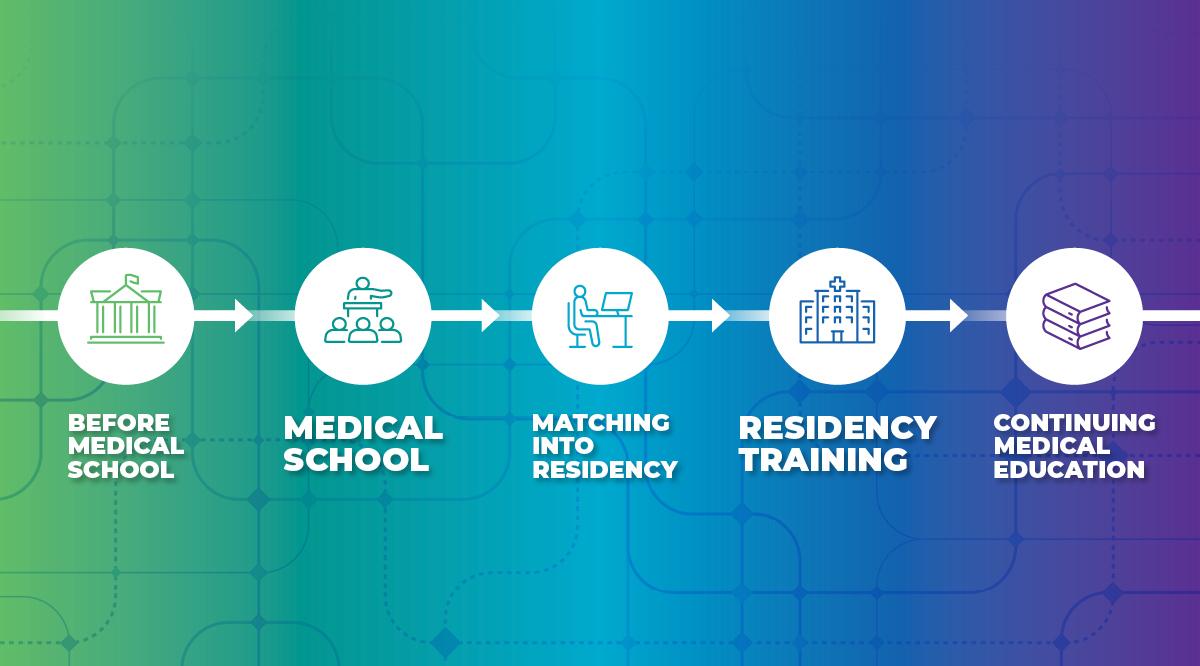
On-ramp: Before medical school
The federal government's role before medical school
Title VII health professions pathway programs administered by the Health Resources and Services Administration (HRSA) — such as the Centers of Excellence, Health Career Opportunity Program, and Scholarships for Disadvantaged Students — collaborate with K-12 and medical educators, prehealth advisors, biomedical researchers, pathway program administrators, and nonprofit leaders to empower students to establish a pathway to careers in medicine and other health professions.
First leg: Medical school
Medical school curriculum covers a wide breadth of content through clinical, classroom, laboratory, and community experiences. Medical students receive a robust education and are continuously assessed for skill acquisition and knowledge of basic sciences such as anatomy and biochemistry; clinical and behavioral sciences to communicate with, evaluate, diagnose, and treat patients with evidence-informed, patient-centered care; and research, professionalism, preventive health, and medical ethics.
Many schools are implementing competency-based medical education, an outcomes-focused approach that emphasizes a learner’s ability to demonstrate specific, observable skills rather than just complete a set number of training hours. In this model, trainees progress once they’ve shown they can safely and effectively perform the tasks needed to care for patients, making the path to becoming a doctor more personalized and aligned with real-world practice.
Each medical school meets rigorous accreditation requirements from the Liaison Commission on Medical Education (LCME®)
while developing its curriculum to meet the health care needs of its community, the unique mission of the medical school, and the learning needs of its students.
The majority of medical school programs are four-year programs. Those that do offer shorter programs work with students to ensure an accelerated model works better for their personal situation and professional goals.
The federal government's role during medical school
Medical students rely on a range of Title IV federal student aid programs to finance their paths to becoming physicians. The primary Title IV graduate program supporting MD students is the William D. Ford Federal Direct Loan Program. Continued support for these programs enables students from all socioeconomic and geographic backgrounds to pursue medical school and allows communities nationwide to benefit from a larger supply of high-quality physicians.
Title VII Area Health Education Centers provide community partnerships with other academic institutions, allowing students to train in a variety of settings, including community health centers, health departments, and primary care. Many Title VII programs support enhanced training for medical and health professions students across a variety of settings and practices, including primary care, pediatrics, geriatrics, mental and behavioral health, addiction, and public health.
Through its Medical Scientist Training Program, the National Institutes of Health provides critical funding for a subset of MD-PhD programs by covering some of the costs for tuition, stipends, and training-related expenses and ensures that the programs provide students with a rigorous training experience in a supportive research training environment.
Mile marker: Residency matching
During the final year of medical school, students choose the type of medicine they will practice based on their personal interests, clinical experiences, and other factors and apply to residency programs. There are more than 200 medical specialties to choose from, including family medicine, pediatrics, emergency medicine, geriatrics, oncology, psychiatry, and surgical specialties like neurosurgery and ophthalmology. Students also develop specialty-specific skills and explore other areas important to medicine, including research, public health, and global health.
Most students are matched to one of their preferred residency programs through the National Resident Matching Program®, SF Match, military, and other specialty match programs. On Match Day in March, all students learn where they will begin their residency training in July.
Next leg: Residency training
During graduate medical education (GME), which lasts from three to seven years, resident physicians receive supervised, hands-on training in programs accredited by the Accreditation Council for Graduate Medical Education.
Residents train as part of a patient care team alongside other health practitioners and under the supervision of attending physicians. Exposure to specialized services, a variety of care settings (including community clinics, rural training sites, and Veterans Affairs facilities), and cutting-edge research and care prepares them to treat all patients, no matter where they choose to practice.
Some residents choose to undertake a fellowship after completing their initial residencies, adding one to three years of study in a subspecialty area.
The federal government's role in residency training
The costs directly associated with this training are supported in part by Medicare Direct Graduate Medical Education (PDF) payments, although these payments have been effectively frozen since 1997.
Teaching hospitals incur $26.49 billion annually in direct training costs. Because of support limitations and other historical factors, Medicare covers only $6.26 billion (24%) of that total.
With projections estimating a persistent shortage of up to 86,000 physicians in the United States by 2036, Congress must increase the number of available Medicare-supported medical residency positions.
Academic medicine and the Department of Veterans Affairs (VA) collaborate in many ways, including training physicians, conducting medical research, and caring for VA patients. Approximately 70% of all U.S. physicians complete part of their training in VA facilities.
The road ahead: Continuing medical education
A physician must obtain a state license to practice medicine. After completing residency, most physicians also become board-certified in their chosen specialty. Twenty-four specialty boards establish criteria physicians must meet to be certified. Licensure is mandatory and granted by state medical boards. Board certification is voluntary but widely expected in practice and academic settings. Specialty boards require regular recertification, a process called continuing certification.
The rapid pace of change in medicine makes continuing medical education programs or continuing professional development essential.
The federal government's role in continuing medical education
Public Service Loan Forgiveness, the National Health Service Corps, and other federal programs help physicians repay and receive forgiveness for loans accrued during medical school in exchange for practicing in public service jobs or in underserved or rural communities.