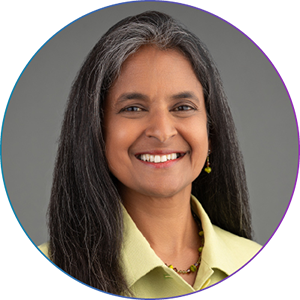
Shobhina Girish Chheda, MD, MPH
University of Wisconsin School of Medicine and Public Health
Across her 25-year career at the University of Wisconsin (UW) School of Medicine and Public Health, Shobhina G. Chheda, MD, MPH, professor of internal medicine and pediatrics and associate dean for medical education, has had a significant impact overseeing the undergraduate medical curriculum and assessment for hundreds of medical students. Leading the Medical Education Office across statewide clinical training sites in partnership with four major health systems, she directs six core teams comprising more than 70 faculty and 10 professional staff. Under her direction, teams are responsible for driving excellence in the undergraduate medical education curriculum and competency-based outcomes.
One of Dr. Chheda’s most transformative achievements has been implementing the ForWard Curriculum, the most extensive curricular reform at the UW School of Medicine and Public Health since 1926. As part of that effort, she led statewide planning, recruited faculty and staff, established the longitudinal teacher-coach program, and managed the transition from the legacy curriculum.
Dr. Chheda also successfully engages her students, leading one to comment that she “created a very welcoming learning environment and encouraged me to challenge myself.” This allowed the student to “take the lead in a way that was very effective for my learning.”
Dr. Chheda has authored more than 40 publications on medical education and has been a significant contributor to Aquifer, a nonprofit, virtual learning platform that provides interactive online courses and resources to more than 320 programs in North America and beyond. As current president of the Aquifer Educators Consortium, she is responsible for all aspects of the consortium’s membership and strategy and leads editors-in-chief who collectively oversee more than 200 virtual case-based courses.
Dr. Chheda has served as founding faculty for two Society of General Internal Medicine programs, TEACH (2012) and MedEd Scholarship (2023), helping to develop hundreds of faculty over the past 15 years. Dr. Chheda served as chair of the board from 2022-25 for the Alliance of Academic Internal Medicine, the professional home for more than 14,000 physicians and staff who directly or indirectly impact medical education.
A leader in medical education locally and nationally, Dr. Chheda has received numerous accolades throughout her career, including the UW School of Medicine and Public Health’s Dean Teaching Award and Clinician Educator of the Year Award from the Midwest Society of General Internal Medicine. In 2023, she was recognized as one of Wisconsin’s Most Influential Asian American Leaders, and the American College of Physicians’ Wisconsin Chapter heralded her as the 2025 Helen Dickie Distinguished Internist of the Year for her exemplary contributions to medical student education leadership, and her commitment to high-quality, longitudinal patient care.
Dr. Chheda earned a BS in nutritional biochemistry with honors from Cornell University in Ithaca, New York, and an MD from the State University of New York at Buffalo School of Medicine and Biomedical Sciences in 1990 (now the Jacobs School of Medicine and Biomedical Sciences at the University at Buffalo). She completed a combined internal medicine and pediatrics residency at North Shore University Hospital-Cornell University Medical College (now Weill Cornell Medicine) in Manhasset, New York, where she was named chief resident. In 2000, she earned an MPH from Saint Louis University School of Public Health (now the Saint Louis University College for Public Health and Social Justice) in Missouri.

David Hirsh, MD, FACP
Harvard Medical School
Since launching his career at Harvard Medical School (HMS) in 1995, David Hirsh, MD, FACP, has been a significant contributor to the field of medical education locally, nationally, and internationally. A vital member of the faculty and a guiding light in academic medicine, Dr. Hirsh currently holds several important roles, including professor of medicine, associate dean for undergraduate medical education with the Cambridge Health Alliance, director of HMS’ Academy Fellowship in Medical Education and Scholarship, and associate director of the Harvard Medical School Academy.
Through wide-ranging scholarship, Dr. Hirsh has advanced the practice and pedagogy of medicine significantly. But his largest contribution has been the co-creation of the Harvard Medical School-Cambridge Integrated Clerkship (CIC). Believed to be the world’s first academic, specialist-based longitudinal integrated clerkship, the CIC translates the empirical sciences of learning into educational design. Its underlying principle of educational continuity, defined by Dr. Hirsh and colleagues in the New England Journal of Medicine, is a core framework in medical education. His work on educational continuity has advanced educational innovations and research with estimates suggesting that 20% of U.S. medical schools and more than 40% of medical schools in Canada and Australia have developed educational models based in educational continuity. Dr. Hirsh has personally been involved in the establishment of many of these programs.
In 2007, Dr. Hirsh co-founded the Consortium for Longitudinal Integrated Clerkships (CLIC), a multinational educational research and advocacy organization. He also created HMS’ standardized patient Objective Structured Clinical Examinations (OSCEs) program, which he directed for 15 years. In that capacity, he co-authored 18 OSCE standardized patient cases, work that has reached more than 2,000 HMS students.
A highly respected mentor and teacher, Dr. Hirsh has provided academic, career, and research mentoring to more than 100 HMS students, residents, and faculty. He has taught seven HMS courses and site-directed three, and started two new courses while co-chairing the committee that created a master’s of medical sciences in medical education program.
Dr. Hirsh has been invited to present on medical education nationally and internationally nearly 400 times, including to audiences numbering in the thousands. He has delivered plenary and other presentations on medicine, obstetrics and gynecology, psychiatry, anatomy, pathology, and other disciplines at organizations such as the AAMC and the Carnegie Foundation, as well as to leaders of the American Board of Pediatrics’ Education in Pediatrics Across the Continuum innovation project.
Dr. Hirsh has received dozens of awards, spanning excellence in teaching, mentorship, research, clinical practice, and public service, including the 2007 Chair Award (with Barbara Ogur, MD) from the National Association of Public Hospitals. Most recently, following a national search, HMS selected Dr. Hirsh as co-director of the Harvard-MIT Program in Health Sciences and Technology and advisory dean and director of the program’s Irving M. London Society.
Dr. Hirsh earned a BA in history summa cum laude from Dartmouth College in 1988 and an MD from the University of Virginia School of Medicine in 1992, where he was honored with a faculty Alpha Omega Alpha designation. He completed postdoctoral training at the University of Michigan, where he was named chief resident.
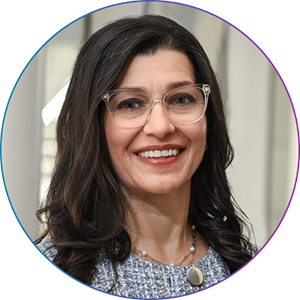
Nadia Ismail, MD, MPH, MEd
Baylor College of Medicine
Nadia Ismail, MD, MPH, MEd, arrived at Baylor College of Medicine (Baylor) in 2005 as assistant professor of medicine and, since then, has become vice dean of the school of medicine and one of the college’s brightest lights in educational leadership and student engagement. As Senior Dean of Faculty Biykem Bozkurt, MD, PhD, noted, “Across every role she has held, [Dr. Ismail] has elevated not only individual students but also the systems and structures through which generations of physicians are prepared to serve.”
As the founding director of the Transitions to Clerkship course, Dr. Ismail transformed student readiness for core clinical rotations, as the program has enrolled nearly 190 students annually. It has achieved one of the best ratings in the curriculum, with students reporting reduced anxiety, greater confidence, and strong clinical engagement. And as director of the Core Internal Medicine Clerkship and Medicine Sub-Internship for eight years, Dr. Ismail led curriculum and assessment innovations with consistently positive outcomes; more than 95% of students rank the clerkship as “good” or “excellent.”
At the institutional level, Dr. Ismail led the first comprehensive curriculum redesign in 25 years while serving as chair of the Curriculum Renewal Working Group. During that process, she guided the development of a vertically integrated, competency-based curriculum and an EPA-aligned program of assessment that now generates more than 20,000 workplace-based assessments annually.
Beyond Baylor, Dr. Ismail has penned multiple MedEdPORTAL publications that have collectively been viewed and downloaded more than 13,000 times. This scholarship has informed curriculum design and implementation of science at institutions across the health sciences sector and led to multiple schools asking her to consult on implementing competency-based, integrated curricula.
Across these roles and duties, Dr. Ismail’s contributions have been measurable, sustained, and transformative, leading to recognition from both students and faculty. In 2025, she received Baylor’s highest teaching distinction, the Barbara and Corbin J. Robertson, Jr. Presidential Award for Excellence in Education for her outstanding contributions to curriculum renewal, fairness in assessment, and mentorship of student and faculty leaders across the medical education continuum. Dr. Ismail has also twice received the highly selective Norton Rose Fulbright Faculty Excellence Award from Baylor’s Academy of Distinguished Educators: in 2014 for Teaching and Evaluation, and in 2015 for Educational Leadership. In recognition of her extraordinary commitment to teaching and mentorship, Dr. Ismail was inducted into the Alpha Omega Alpha Honor Medical Society in 2026.
Dr. Ismail earned a BA from the University of Texas at Austin in 1993 and an MPH and MD from the University of Texas Health Science Center at San Antonio (now the University of Texas Health Science Center at San Antonio Joe R. and Teresa Lozano Long School of Medicine). She completed postgraduate training in internal medicine at the University of Illinois College of Medicine at Chicago in 2002 and earned a master of education degree from the University of Houston in 2007.
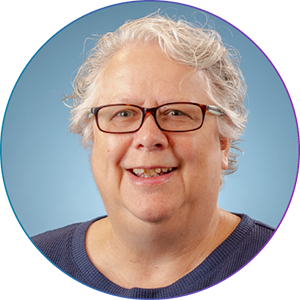
Julie Anne Kerry, PhD
Macon & Joan Brock Virginia Health Sciences Eastern Virginia Medical School at Old Dominion University
After 16 years leading a variety of NIH-funded investigations into molecular virology, viral gene regulation, and host-virus interactions, Julie Anne Kerry, PhD, turned her attention to medical education. Since then, she has had a significant impact on learners, particularly preclerkship students at the Macon & Joan Brock Virginia Health Sciences Eastern Virginia Medical School at Old Dominion University (EVMS). As one student succinctly put it, Dr. Kerry is the “best instructor I’ve ever had.”
Now the EVMS Foundation Distinguished Professorship in Biomedical Sciences and professor of biomedical and translational sciences, Dr. Kerry also serves as vice chair of faculty development. In these roles, she leverages her extensive research background to bring a methodical, measurable approach to improving the medical school experience, with a particular focus on the first 18 months of medical school.
Her interest in addressing foundational deficiencies in preclerkship learners began in 2016 when she attended the Harvard Macy Institute Program for Educators in Health Professions. There, she led the development of an intervention program for struggling medical learners, which has evolved to become the Proficiency Enhancement Program (PEP) at EVMS, an optional program that runs parallel to the first-year curriculum. Dr. Kerry directs the program, which began with four students in 2016. Students are mentored by three faculty members who oversee weekly sessions that aid students in learning while providing a collaborative and supportive environment that encourages active learning and higher-order thinking. In 2025, over 80% of the MD cohort was enrolled, and one student noted the program has been “essential to my success.”
Spurred by the impact of PEP, Dr. Kerry collaborated with other faculty and the academic development team to create PREPARE, a prematriculation program designed to assist students in the transition to medical school. Now in its fourth year, the program continues to grow. Dr. Kerry also served as chair of EVMS’ Medical Education Committee from 2014 to 2023, overseeing the development and implementation of the CareForward Curriculum that transitioned the preclerkship phase from discipline-based to an integrated systems-based curriculum.
Nationally, Dr. Kerry was selected as the molecular biology lead for the Aquifer Sciences Initiative and serves on the Aquifer Sciences Editorial Board.
For her significant contributions, Dr. Kerry has received numerous awards and accolades, including the 2024 Faculty Award for Outstanding Achievement, EVMS’ highest faculty award. She was elected to the Gold Humanism Honors Society in 2023 and the Alpha Omega Alpha Honor Medical Society in 2024.
Dr. Kerry earned a BS in medical laboratory science and an MS in biochemistry from the University of South Australia in Adelaide (now Adelaide University). In 1989, she earned a PhD in molecular biology at Monash University in Melbourne. She completed postdoctoral fellowship training in virology at the University of California, Santa Barbara, in 1991 and joined the faculty at EVMS in 1992.